
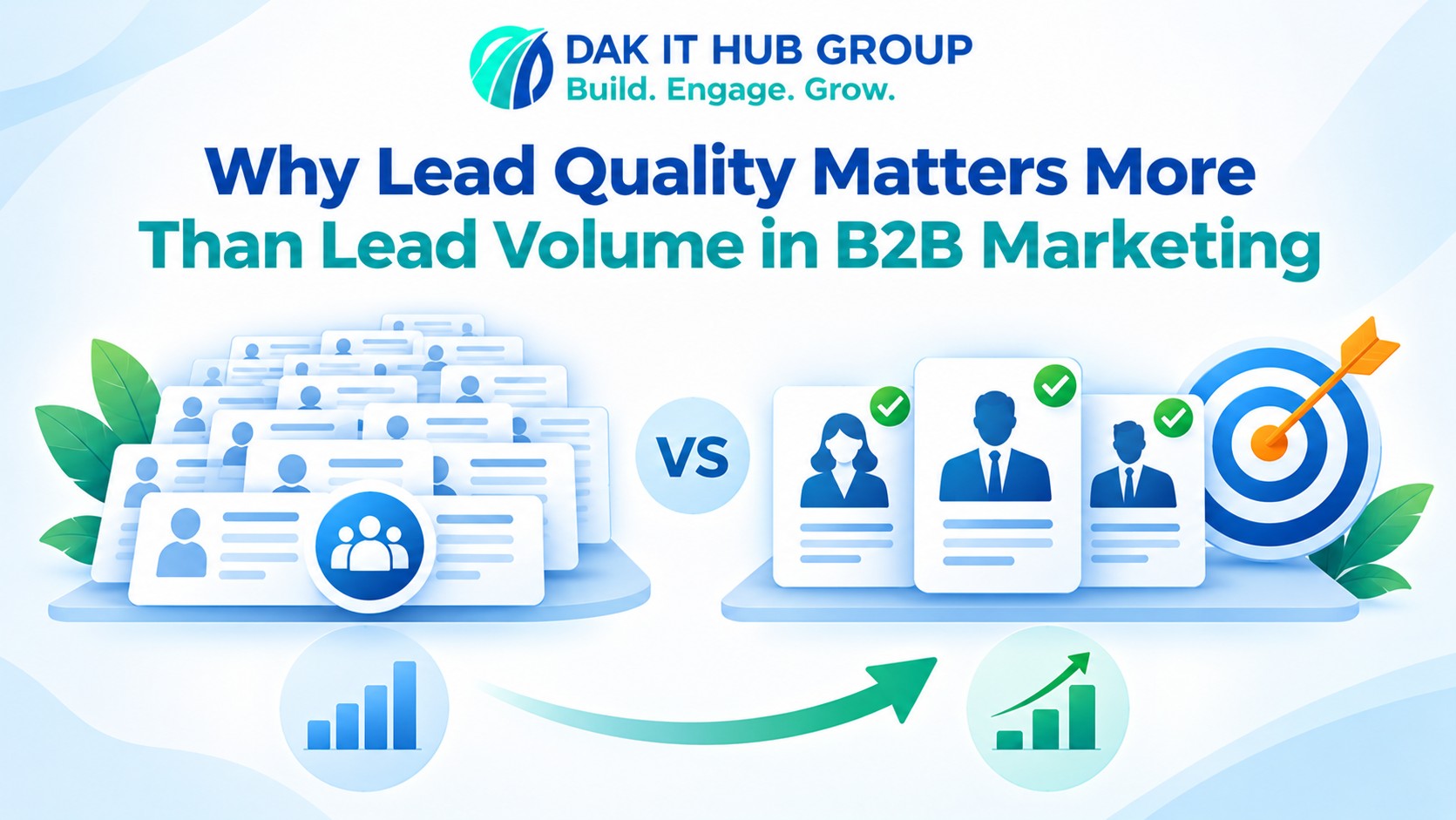
Generating a high number of leads is often considered a sign of successful B2B marketing. Businesses invest in email campaigns, telemarketing, content syndication, paid advertising, and other promotional activities to attract potential customers. However, a large lead database does not necessarily translate into more sales opportunities or higher revenue.
The real measure of an effective B2B lead generation strategy is not simply how many contacts a campaign produces, but how many of those contacts represent genuine business opportunities.
A campaign generating hundreds of leads may deliver limited results if most contacts do not match the ideal customer profile, lack purchasing authority, have no relevant business requirement, or are not interested in engaging with the sales team. In contrast, a smaller number of carefully targeted and qualified leads can create more meaningful conversations and improve sales efficiency.
This is why lead quality matters more than lead volume in B2B marketing. By prioritizing relevance, accurate targeting, and structured qualification, businesses can build stronger sales pipelines, improve marketing efficiency, and create better alignment between marketing and sales teams.
1. Understanding the Difference Between Lead Quality and Lead Volume
Lead volume refers to the total number of leads generated through marketing and prospecting activities. It measures the quantity of contacts collected during a campaign.
Lead quality, on the other hand, evaluates how relevant and valuable those contacts are to the business.
A high-quality B2B lead generally demonstrates several important characteristics:
- Ideal customer profile alignment: The prospect works for an organization that matches the business’s target industry, company size, geography, and other relevant criteria.
- Relevant job role: The contact has responsibilities connected to the product or service being offered.
- Business need: The organization has a challenge, requirement, or objective that the solution can address.
- Decision-making influence: The prospect participates in evaluating, recommending, or approving purchasing decisions.
- Engagement: The prospect demonstrates relevant interest or willingness to consider further discussions.
- Buying readiness: The prospect has an appropriate purchasing requirement or a realistic path toward evaluating a solution.
A lead can meet some of these criteria without meeting all of them. Therefore, businesses should evaluate leads against predefined qualification requirements rather than treating every contact as equally valuable.
2. High Lead Volume Can Increase Sales and Marketing Costs
Generating large numbers of leads may appear attractive, but poor-quality leads can create additional work for both marketing and sales teams.
Sales representatives often spend considerable time researching contacts, making calls, sending follow-up emails, and attempting to arrange meetings. When a significant proportion of leads are irrelevant or unsuitable, these activities consume resources without creating meaningful opportunities.
For example, consider a B2B software company targeting organizations with more than 200 employees. A campaign that generates 500 contacts may appear successful initially. However, if most contacts belong to small businesses, unrelated departments, or organizations outside the target geography, the campaign may deliver limited commercial value.
A smaller campaign producing 100 relevant contacts from companies that match the target profile could provide better opportunities for sales engagement.
Prioritizing lead quality helps businesses reduce wasted outreach efforts and allocate resources toward prospects with a stronger likelihood of becoming customers.
3. Better Lead Quality Improves Sales Team Productivity
Sales productivity depends heavily on the relevance and accuracy of the opportunities passed from marketing.
When sales teams receive properly targeted and qualified leads, they can spend more time understanding business requirements, discussing solutions, and developing relationships instead of repeatedly filtering unsuitable contacts.
High-quality lead generation supports sales productivity in several ways:
- Reduces time spent contacting irrelevant prospects.
- Improves the relevance of initial sales conversations.
- Helps representatives prioritize promising opportunities.
- Provides better context for personalized follow-ups.
- Supports more effective appointment-setting activities.
For example, a sales representative approaching an IT director who is actively evaluating data management solutions can have a more focused discussion than when contacting a professional whose responsibilities have no connection to the offering.
The objective is not simply to provide sales teams with more contacts. It is to provide contacts that have a meaningful connection to the business solution.
4. Accurate Targeting Is the Foundation of Lead Quality
Lead quality begins before a campaign is launched. Businesses must first understand which organizations and professionals are most likely to benefit from their products or services.
This requires developing a clear Ideal Customer Profile (ICP) and defining the target audience.
Important targeting considerations include:
Industry: Identify sectors where the product or service addresses relevant business challenges.
Company size: Define employee count, revenue range, or organizational scale according to the offering.
Geography: Select countries and regions where the business can effectively serve potential customers.
Job titles and departments: Identify professionals responsible for evaluating, recommending, or purchasing the solution.
Business requirements: Consider the operational challenges, technology requirements, or strategic priorities that create demand for the offering.
For example, a company providing enterprise cybersecurity services may prioritize Chief Information Security Officers, IT directors, security managers, and technology executives at mid-sized and large organizations.
A clearly defined target audience helps marketing teams focus campaign resources on relevant prospects and improves the chances of generating qualified leads.
5. Use BANT Qualification to Identify Stronger Opportunities
Targeting the right audience is important, but company and job-title information alone cannot establish whether a prospect represents a genuine sales opportunity.
This is where structured lead qualification frameworks such as BANT become valuable.
BANT evaluates prospects across four important dimensions:
- Budget: Does the organization have an allocated budget or a realistic path to securing funding?
- Authority: Is the contact responsible for making or influencing the purchasing decision?
- Need: Does the organization have a business requirement that the solution can address?
- Timeline: When does the organization expect to evaluate or implement a solution?
BANT qualification helps sales and marketing teams understand the prospect’s purchasing context rather than relying only on initial interest.
Not every lead needs to demonstrate immediate purchasing readiness. Some prospects may have a relevant requirement but need additional time to secure funding or obtain internal approval.
Documenting these details allows businesses to distinguish between immediate sales opportunities and prospects that require further nurturing.
6. Combine Email Marketing and Telemarketing for Better Lead Quality
Email marketing and telemarketing can work together to support targeted B2B lead generation.
Email marketing provides a scalable way to introduce relevant business solutions, distribute useful content, and engage professionals across selected industries and job roles.
For example, a campaign targeting finance directors may focus on cost optimization, financial visibility, and operational efficiency, while a campaign targeting IT leaders may highlight technology integration, infrastructure, and security challenges.
Relevant email campaigns can help identify prospects who are interested in learning more about a particular subject or solution.
Telemarketing complements this activity by enabling direct conversations with potential buyers. Trained callers can explore business requirements, understand existing challenges, identify decision-making responsibilities, and gather information about purchasing timelines.
The two channels serve complementary purposes:
Email marketing helps with:
- Reaching relevant business audiences.
- Introducing products, services, and industry resources.
- Encouraging prospects to engage with relevant content.
- Supporting ongoing prospect nurturing.
Telemarketing helps with:
- Validating prospect information.
- Exploring business needs and requirements.
- Identifying decision-makers and influencers.
- Gathering BANT qualification information.
- Establishing interest in further discussions.
When coordinated effectively, these channels can help businesses move beyond contact collection and develop more meaningful prospect relationships.
7. Align Marketing and Sales Around Lead Acceptance Criteria
One of the common reasons B2B lead generation programs underperform is a lack of agreement between marketing and sales regarding what constitutes a qualified lead.
Marketing teams may focus on campaign performance and the number of contacts delivered, while sales teams may prioritize purchasing authority, business requirements, and immediate sales potential.
Without clearly defined acceptance criteria, even a campaign that generates relevant contacts can experience disagreements over lead quality.
To avoid this, both teams should establish qualification requirements before campaign execution.
These should cover:
- Target industries and company sizes.
- Relevant job titles and seniority levels.
- Required contact information.
- Business need and qualification criteria.
- Expected purchasing authority.
- Follow-up and lead acceptance procedures.
Sales teams should also provide structured feedback on delivered leads. This information can help marketing refine audience selection, improve messaging, and adjust campaign qualification processes.
A consistent feedback loop ensures that lead quality becomes a shared responsibility rather than a metric owned by only one department.
8. Measure Lead Quality Beyond Total Lead Count
Businesses need appropriate performance metrics to understand whether their lead generation campaigns are producing valuable results.
Instead of evaluating campaigns exclusively through the number of leads generated, organizations should monitor several quality-focused indicators.
| Performance metric | What it measures |
| ICP match rate | Reliability of prospect information |
| Qualification rate | Percentage of leads meeting agreed qualification criteria |
| Sales acceptance rate | Percentage of leads accepted by sales teams |
| Meeting conversion rate | Percentage of leads progressing to relevant sales meetings |
| Opportunity conversion | Leads progressing into genuine sales opportunities |
| Cost per qualified lead | Campaign expenditure relative to qualified leads generated |
These metrics provide a more meaningful picture of campaign effectiveness.
For example, a campaign with a high total lead count but a low qualification rate may require better targeting or stricter audience selection. A campaign with fewer leads but stronger sales acceptance may represent a more effective use of marketing resources.
Ultimately, businesses should evaluate lead generation based on its contribution to sales opportunities and pipeline development rather than contact volume alone.
Conclusion
In B2B marketing, generating more leads does not automatically mean generating more business. High lead volume can increase campaign activity, but without accurate targeting, relevant contact information, and structured qualification, it may create unnecessary work for sales teams and reduce marketing efficiency. Prioritizing lead quality helps businesses focus on prospects that match their ideal customer profile, have relevant business requirements, and can contribute to meaningful sales conversations. By combining targeted email marketing, telemarketing, BANT qualification, and continuous marketing-sales alignment, organizations can build stronger pipelines and make better use of their lead generation investments.
DAK IT HUB GROUP helps businesses strengthen their B2B lead generation efforts through targeted email marketing and telemarketing services. Our approach focuses on reaching relevant business audiences, identifying potential buyers, and engaging decision-makers through coordinated outreach campaigns. By combining audience targeting, prospect engagement, and structured lead qualification, DAK IT HUB GROUP helps businesses generate relevant MQL, SQL, and BANT leads that support sales and marketing objectives. Rather than focusing only on the number of contacts generated, our B2B lead generation services emphasize connecting businesses with prospects who are more aligned with their offerings and potential sales opportunities.
0 Comments