
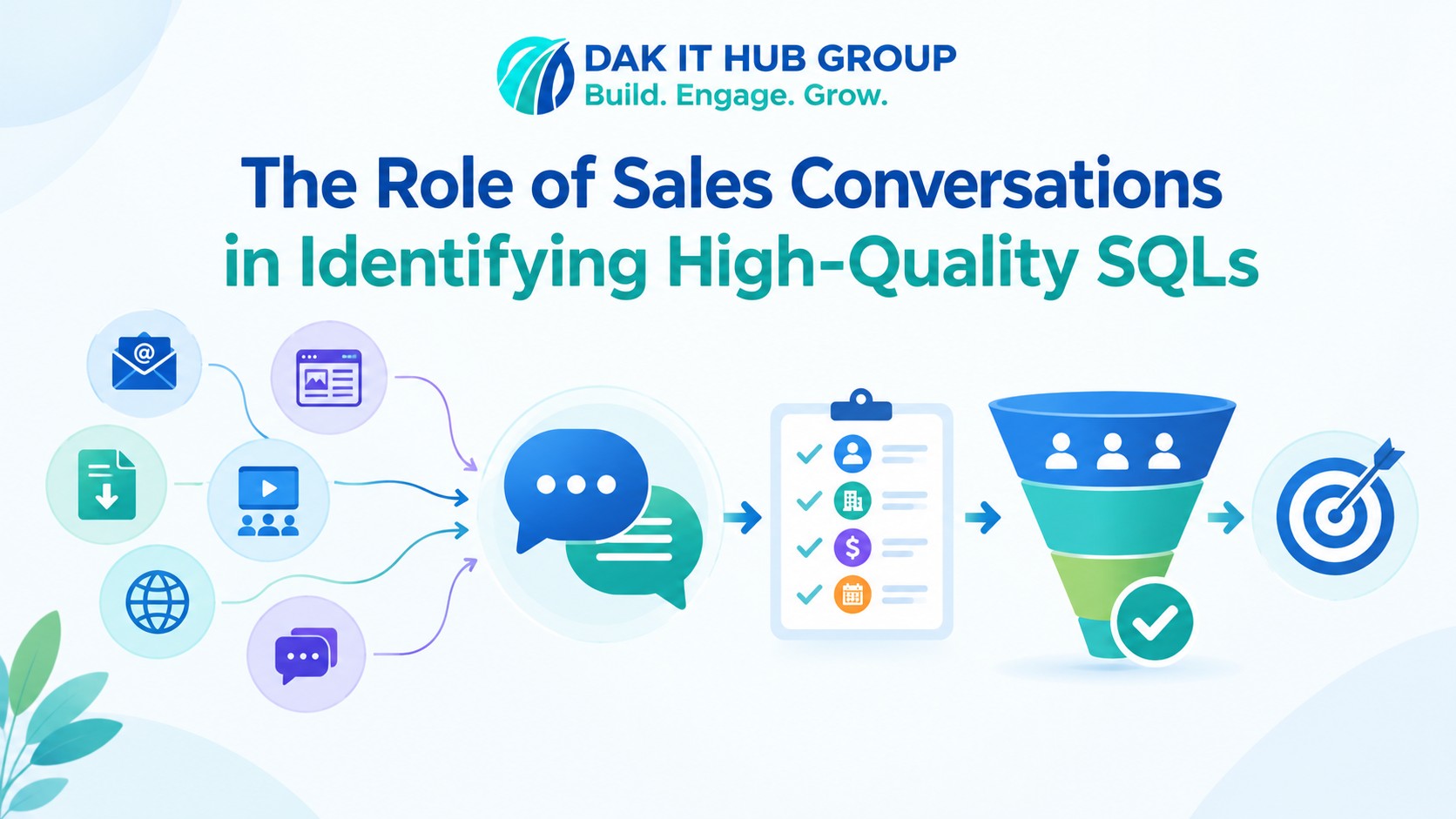
Generating Marketing Qualified Leads (MQLs) is an important part of the B2B demand-generation process, but an MQL is not automatically ready for sales. A prospect may download content, attend a webinar, engage with emails or repeatedly visit a website without having an active buying requirement.
This is where sales conversations become critical.
A Sales Qualified Lead (SQL) represents a prospect that has moved beyond marketing engagement and has been reviewed or validated by sales as worth actively pursuing. The transition from MQL to SQL is therefore less about a lead reaching an arbitrary score and more about confirming whether genuine business potential exists.
Why Sales Conversations Matter in SQL Qualification
Digital engagement can provide useful signals, but it rarely tells the complete story.
For example, a prospect may download a whitepaper because they are conducting general research. Another prospect may download the same whitepaper because their organization is actively evaluating solutions.
The digital activity looks identical, but the underlying intent is very different.
A sales conversation gives the business an opportunity to understand why the prospect is interested, what problem they are experiencing and whether there is a realistic opportunity to move forward.
This human validation is one of the key differences between an MQL and a high-quality SQL.
Move From Engagement to Business Need
The first objective of a qualification conversation should be understanding the prospect’s actual business problem.
Instead of immediately presenting a product or service, sales representatives should explore questions such as:
- What challenge is the organization currently facing?
- How is the problem affecting the business?
- What prompted the organization to investigate a solution?
- How is the issue currently being handled?
- What would the organization like to improve?
These questions help separate genuine business requirements from general curiosity.
A prospect who can clearly explain a problem and its business impact provides a much stronger SQL signal than someone who simply says they are “interested.”
Confirm ICP and Company Fit
A sales conversation should also validate whether the prospect actually fits the company’s Ideal Customer Profile (ICP).
Important considerations can include:
- Industry
- Company size
- Geography
- Department
- Job responsibility
- Business model
- Existing technology or infrastructure
- Relevant use case
A prospect can demonstrate strong engagement and still be a poor sales opportunity if the company does not match the target market.
Therefore, high-quality SQL qualification should combine engagement with business fit, rather than treating engagement alone as proof of sales readiness.
Identify the Decision-Making Process
B2B purchases frequently involve multiple stakeholders. The person responding to an outreach campaign may be an end user, researcher, influencer or decision-maker.
A good qualification conversation should establish how the buying process works.
Sales representatives can ask:
“Who else would typically be involved in evaluating a solution like this?”
or:
“How does your organization normally make decisions around this type of investment?”
The objective is not to pressure the prospect into revealing every stakeholder immediately. It is to understand whether there is a realistic path to the people involved in the decision.
Authority and access to the buying process are commonly considered important elements of SQL qualification.
Validate Budget and Commercial Readiness
Budget does not always need to mean that a specific purchase order already exists.
However, sales should try to determine whether there is a realistic commercial path forward.
Useful questions might include:
- Has a budget been allocated?
- Is the organization currently evaluating vendors?
- Would this require a new budget approval?
- What level of investment is normally considered for this type of project?
The conversation should be appropriate to the prospect’s stage. Asking for an exact budget too early can make a discovery conversation feel transactional.
The objective is to determine whether the prospect has the financial ability and organizational process required to move forward.
Establish a Realistic Timeline
Timing is another critical SQL indicator.
A prospect may have a genuine need but no intention of addressing it for another two years. That prospect may be valuable for long-term nurturing but should not necessarily receive the same SQL priority as a company actively evaluating solutions this quarter.
Sales conversations can uncover important timing information by asking:
- When are you looking to address this?
- Is there a specific business event driving the project?
- Are you currently evaluating solutions?
- When would you ideally like to implement a solution?
Need, authority, budget and timeline are commonly used as qualification dimensions because they help distinguish genuine opportunities from general interest.
Listen for Buying Signals
Qualification is not simply about completing a checklist.
Sales representatives should listen for buying signals during the conversation.
Examples include:
- The prospect describes a specific business problem.
- They explain the consequences of leaving the problem unresolved.
- They ask detailed questions about the solution.
- They discuss implementation requirements.
- They mention internal stakeholders.
- They provide a realistic timeframe.
- They agree to a specific next step.
These signals provide context that a lead score alone may not capture.
A strong SQL is therefore not simply a lead that answered enough questions. It is a prospect where the conversation has produced credible evidence that further sales engagement is justified.
Document the Conversation Clearly
A qualification conversation creates valuable information that should not remain only in the salesperson’s memory.
Key findings should be documented in the CRM or lead record, including:
- Confirmed business need
- Relevant pain points
- Company and role fit
- Decision-making involvement
- Budget information
- Expected timeline
- Current solution or approach
- Agreed next step
- Qualification outcome
This creates a clearer handoff between SDRs, sales representatives and account executives.
It also gives marketing teams valuable feedback about the types of leads their campaigns are producing.
Align Marketing and Sales on SQL Criteria
One of the biggest challenges in B2B lead generation occurs when marketing and sales use different definitions of a qualified lead.
Marketing may consider a prospect qualified because of engagement, while sales may reject the same prospect because there is no identifiable need or timeline.
A shared SQL definition can reduce this disconnect.
Marketing and sales should agree on:
1. What constitutes an MQL.
2. What conditions must be met before sales accepts the lead.
3. Which qualification criteria are mandatory.
4. What evidence is required during a sales conversation.
5. When a lead should become an SQL.
6. When a lead should be returned to nurturing.
Some organizations also introduce a Sales Accepted Lead (SAL) stage between MQL and SQL to distinguish sales acceptance from completed sales qualification.
Use Conversations to Improve Future Lead Generation
Sales conversations are valuable not only for qualifying today’s leads but also for improving tomorrow’s campaigns.
If sales repeatedly discovers that certain MQLs lack a genuine business need, marketing can adjust its targeting or scoring criteria.
Similarly, if certain industries, job titles, content topics or engagement patterns consistently produce strong SQLs, marketing can prioritize them in future campaigns.
This creates a feedback loop:
Lead Generation → MQL → Sales Conversation → SQL → Sales Outcome → Campaign Optimization
Over time, this can help organizations move from simply generating more leads to generating better-quality leads.
Final Thoughts
Sales conversations provide the human context needed to distinguish genuine sales opportunities from surface-level engagement. By validating business need, ICP fit, decision-making involvement, budget, timing and next steps, sales teams can identify higher-quality SQLs and avoid wasting resources on prospects that are not ready for active pursuit. DAK IT HUB GROUP’s B2B lead generation services help businesses generate and qualify SQL leads through targeted email marketing and telemarketing. By combining relevant prospect targeting, structured email outreach and direct telemarketing conversations, DAK IT HUB GROUP helps businesses identify genuine interest, understand prospect requirements and deliver more sales-ready SQL opportunities to their sales teams.
0 Comments