
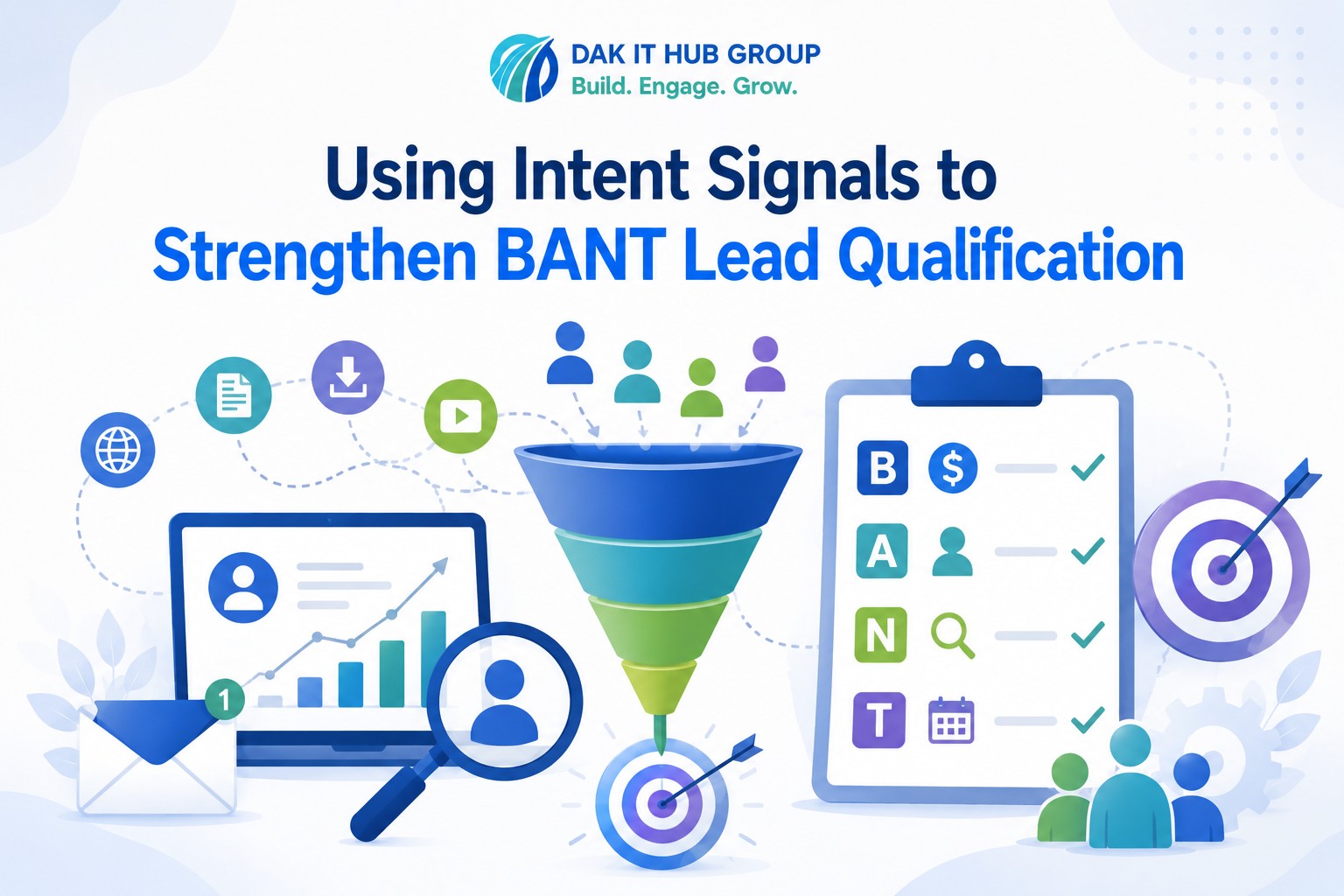
B2B sales teams often use the BANT framework to determine whether a prospect is a good sales opportunity. BANT stands for Budget, Authority, Need, and Timeline. While this framework remains useful, today’s B2B buying process is more complex than simply asking a prospect four questions and checking four boxes.
Modern buyers conduct extensive research before speaking with sales teams. They visit websites, download content, attend webinars, read blogs, compare solutions, and interact with marketing emails. These activities create valuable intent signals that can help sales and marketing professionals understand how seriously a prospect is considering a solution.
Combining intent signals with BANT qualification can make lead qualification more accurate and help sales teams focus on prospects with stronger buying potential.
What Are Intent Signals?
Intent signals are actions or behaviors that indicate a prospect may be interested in a particular product, service, or business solution.
Common intent signals include:
- Visiting product or service pages
- Downloading whitepapers and eBooks
- Attending webinars
- Clicking links in marketing emails
- Repeatedly visiting a company’s website
- Reading multiple articles about the same topic
- Requesting product information
- Engaging with case studies
- Responding to sales outreach
One activity alone may not indicate strong buying intent. However, several related activities over a period of time can provide a clearer picture of a prospect’s interest.
Why Combine Intent Signals With BANT?
Traditional BANT qualification depends heavily on information collected during sales conversations. A prospect may say they have a need and authority, but the sales representative may not have enough information to understand how actively the company is researching a solution.
Intent signals add another layer of information.
For example, a prospect may download an industry report, attend a webinar, visit a product page several times, and then respond to an email. These behaviors suggest a higher level of interest than a single content download.
By combining these signals with BANT, sales teams can make more informed qualification decisions.
Using Intent Signals to Understand Budget
Budget can sometimes be difficult to discuss early in a B2B sales conversation. Prospects may not want to reveal their budget before they fully understand the value of a solution.
Intent signals can provide useful context.
For example, prospects who repeatedly visit pricing pages, download solution comparisons, or request detailed product information may be further along in their evaluation process.
These signals do not prove that a budget has been approved, but they can indicate that the prospect is seriously researching potential solutions.
Sales representatives can then use this information to ask better questions about purchasing plans and available resources.
Identifying Authority Through Engagement
B2B purchases often involve several people. The person engaging with your marketing content may not always be the final decision-maker.
Intent signals can help identify potential members of the buying committee.
For example, if a marketing manager, IT director, and procurement professional from the same company interact with related content, this could indicate that the organization is evaluating a solution.
Sales teams can use these insights to identify stakeholders and understand their roles in the purchasing process.
Instead of assuming that one contact represents the entire buying team, sales representatives can work toward a more complete picture of decision-making authority.
Understanding Need Through Content Engagement
The “Need” component of BANT focuses on whether the prospect has a genuine business problem that your solution can address.
Intent signals can provide useful clues about that need.
Suppose a company repeatedly engages with content about improving data quality. Its employees may download a data management guide, attend a webinar about data challenges, and visit relevant service pages.
These activities can suggest that data quality is an important business concern.
Sales representatives can use these signals to start more relevant conversations rather than relying on generic questions.
Understanding the Buying Timeline
Timeline is another important part of BANT qualification.
A prospect may have a genuine need and sufficient budget but may not be planning to purchase for another year. Another prospect may be actively evaluating solutions and looking to make a decision within the next few months.
Intent signals can help identify changes in buying activity.
An increase in website visits, content downloads, webinar attendance, and email engagement may indicate that research activity is increasing.
Sales teams can use these changes to prioritize prospects who appear to be moving closer to a purchasing decision.
Create an Intent-Based Lead Scoring Model
Businesses can strengthen BANT qualification by incorporating intent signals into their lead scoring system.
For example, companies could assign higher scores to actions such as:
- Visiting pricing or product pages
- Requesting information
- Attending product-focused webinars
- Responding to sales emails
- Downloading multiple related resources
Lower-value activities, such as a single blog visit, may receive fewer points.
The scoring model should also consider company fit and job role. A highly engaged contact from a company that matches the Ideal Customer Profile (ICP) may deserve greater sales attention than an equally engaged contact from an unrelated company.
Use Multiple Signals Instead of One Action
A common mistake is treating one activity as proof of buying intent.
Someone downloading a whitepaper does not necessarily mean they are ready to purchase. They may simply be conducting research.
The stronger approach is to look for patterns of behavior.
For example:
Content download → webinar attendance → website visits → email engagement → sales response
A sequence like this provides stronger evidence of interest than any individual action.
Combining multiple signals with BANT questions can help sales teams qualify opportunities more confidently.
Improve Sales and Marketing Alignment
Intent-based BANT qualification can also improve collaboration between sales and marketing teams.
Marketing teams can identify prospects demonstrating relevant engagement and provide sales with information about their activities. Sales teams can then validate those signals through direct conversations.
Sales feedback can also help marketing refine its targeting and lead scoring models.
This creates a continuous feedback loop where both teams learn which behaviors are most closely associated with qualified opportunities.
Avoid Treating Intent as a Guarantee
Intent signals are valuable, but they should not replace human qualification.
A prospect can show strong online activity without having an approved budget or purchasing authority. Similarly, someone may have a genuine need but demonstrate limited digital engagement.
Intent signals should therefore be used as supporting evidence, not as automatic proof of qualification.
The strongest approach combines behavioral signals with direct conversations and structured BANT questions.
Final Thoughts
Using intent signals alongside BANT can give B2B sales teams a more complete view of prospect readiness. Instead of relying only on information gathered during a sales call, businesses can consider how prospects interact with content, websites, webinars, and email campaigns. When these behavioral signals are combined with Budget, Authority, Need, and Timeline, sales teams can prioritize better opportunities, personalize outreach, and improve the quality of their sales pipeline.
DAK IT HUB GROUP’s B2B lead generation services help businesses generate and qualify BANT leads through targeted email marketing and telemarketing. By reaching relevant decision-makers through email campaigns and validating their business needs, authority, budget, and purchasing timelines through telemarketing conversations, DAK IT HUB GROUP helps sales and marketing professionals identify stronger BANT-qualified opportunities and build a more sales-ready pipeline.
0 Comments