
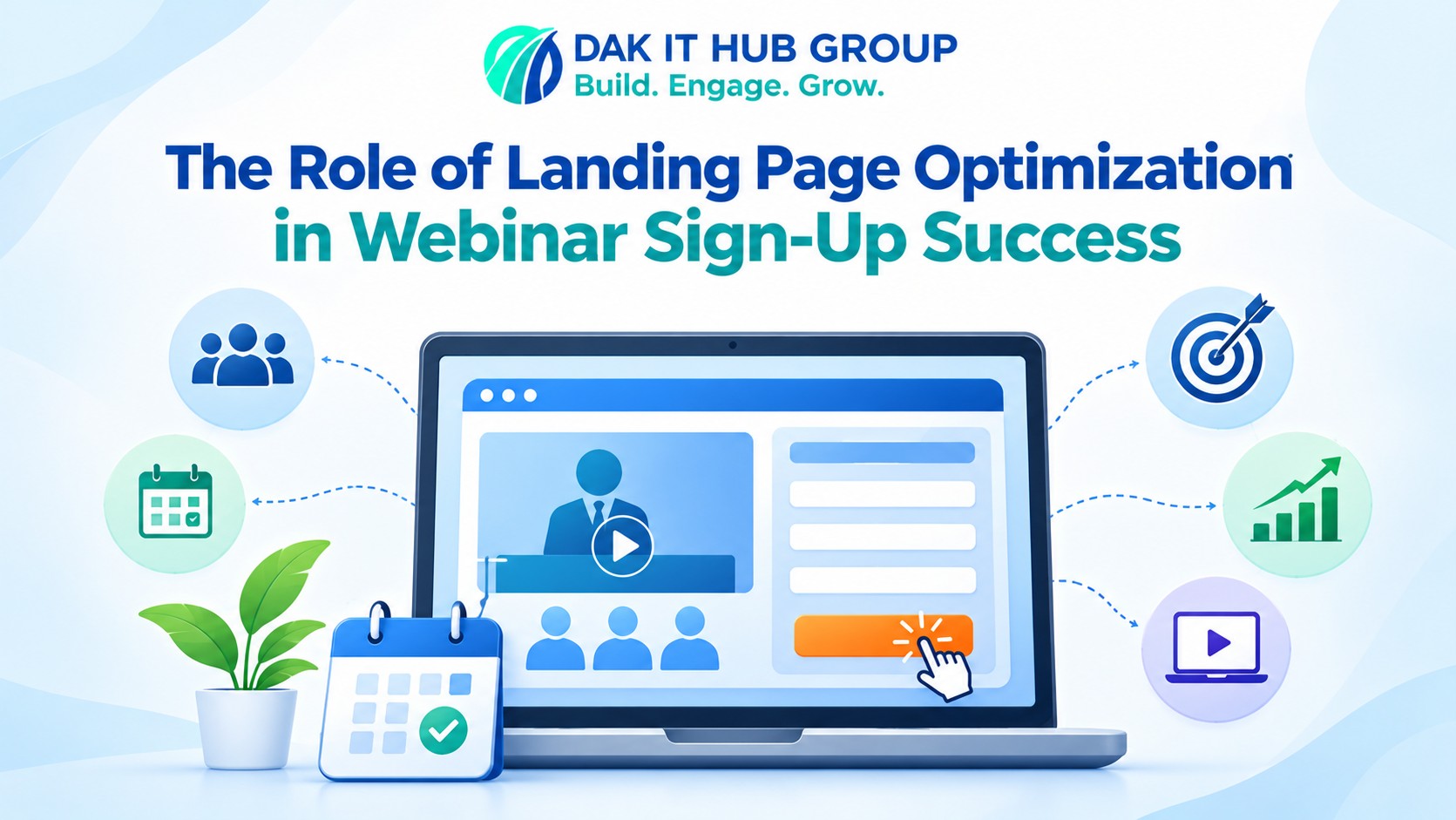
Webinars have become an effective marketing channel for B2B organizations looking to educate potential customers, showcase industry expertise, generate qualified leads, and build relationships with decision-makers. Whether businesses are hosting product demonstrations, industry discussions, expert sessions, or educational presentations, webinars provide an opportunity to engage audiences around specific business challenges.
However, attracting the right audience to a webinar requires more than sending promotional emails or publishing event announcements on social media. Prospective attendees need a clear reason to register, confidence in the event’s value, and a simple process for completing their sign-up.
This is where landing page optimization plays an important role.
A webinar landing page is often the first dedicated destination prospects visit after clicking an invitation or promotional message. It must communicate the event’s value, answer important questions, establish credibility, and encourage visitors to complete the registration process.
Even a well-planned webinar campaign can experience poor registration performance if its landing page is confusing, slow, difficult to navigate, or missing essential information. By optimizing the landing page experience, businesses can reduce registration friction, improve visitor engagement, and convert more relevant prospects into registered attendees.
1. Create a Clear and Compelling Webinar Value Proposition
The first objective of a webinar landing page is to communicate why someone should attend.
Visitors typically make a quick decision about whether an event is relevant to their professional responsibilities and current business priorities. If the page headline is vague or focuses only on the webinar title, potential attendees may not immediately understand what they will gain.
An effective landing page should highlight the primary benefit of attending rather than simply describing the subject.
For example, instead of using a generic headline such as “Digital Transformation Webinar,” a more compelling approach could be “How to Improve Operational Efficiency Through Digital Transformation.”
The value proposition should answer three important questions:
- What business challenge will the webinar address?
- What practical insights or knowledge will attendees gain?
- Why is this topic relevant to the intended audience?
The headline, supporting introduction, and key benefits should work together to establish the event’s relevance.
For B2B webinars, messaging should be aligned with the interests of the intended audience, such as business executives, IT professionals, marketing leaders, finance directors, or operations managers.
2. Keep the Registration Form Simple and User-Friendly
The registration form is one of the most important elements of a webinar landing page. Even when visitors are interested in the event, a lengthy or complicated form can discourage them from completing registration.
Businesses should collect only the information necessary for registration and appropriate lead qualification.
Common registration fields include:
- First and last name.
- Business email address.
- Company name.
- Job title.
- Country or region.
Additional questions may be useful for certain B2B campaigns, but every extra field should have a clear purpose.
For example, asking about company size or business challenges may help segment registrants for future marketing activities. However, requesting too much information during the initial sign-up can create unnecessary friction.
A good registration form should also feature clearly labelled fields, readable instructions, visible error messages, and an easy-to-find submit button.
The objective is to make registration straightforward while collecting enough information to understand who is interested in attending.
3. Highlight the Webinar Agenda and Key Takeaways
Prospective attendees want to know what they will learn before committing their time.
A landing page that provides only the webinar title, date, and registration button may not communicate enough value to encourage sign-ups.
Including a concise agenda helps visitors understand the topics that will be discussed and the practical insights they can expect.
For example, a B2B technology webinar might cover:
- Current industry challenges and emerging trends.
- Common implementation obstacles.
- Practical strategies and recommended approaches.
- Industry examples or real-world applications.
- Questions and answers with the speakers.
Clearly presenting these details helps visitors evaluate whether the webinar matches their professional interests.
It is also useful to highlight specific learning outcomes. Instead of simply stating that a webinar will discuss cybersecurity, explain that attendees will explore ways to identify security vulnerabilities, strengthen risk management, and improve organizational preparedness.
Specific outcomes make the event proposition more tangible and relevant.
4. Establish Credibility Through Speaker Information
The credibility of the speakers can influence a visitor’s decision to register.
B2B audiences often look for webinars featuring professionals with relevant industry experience, subject expertise, or practical knowledge.
A landing page should introduce the speakers and explain why their insights are worth hearing.
Useful speaker information includes:
- Full name and professional designation.
- Company and current role.
- Relevant industry experience.
- Areas of specialization.
- Professional achievements or subject expertise.
For example, a webinar about enterprise technology adoption may attract more interest when presented by an experienced technology executive or an industry specialist with practical implementation experience.
Speaker information should be concise and relevant. The objective is to demonstrate expertise and build confidence without overwhelming visitors with lengthy biographies.
Where appropriate, including professional photographs, company logos, and links to verified speaker profiles can further strengthen credibility.
5. Optimize the Landing Page for Mobile Devices
Many professionals discover webinars through email invitations, LinkedIn posts, and other digital channels using mobile devices.
If the landing page is difficult to view or complete on a smartphone, potential attendees may abandon the registration process.
Mobile optimization should therefore be a standard requirement rather than an optional enhancement.
Important considerations include:
- Responsive layouts that adapt to different screen sizes.
- Readable fonts and appropriate spacing.
- Registration forms that are easy to complete on touchscreens.
- Clearly visible calls to action.
- Properly sized images and visual elements.
- Fast loading times and minimal unnecessary page components.
The registration experience should remain consistent across desktops, tablets, and smartphones.
Businesses should test their landing pages on multiple devices and browsers before launching promotional campaigns. This helps identify layout problems, broken buttons, form errors, and other issues that could affect registration performance.
6. Use Strong and Visible Calls to Action
A call to action (CTA) guides visitors toward the desired next step.
For webinar landing pages, the primary CTA is usually the registration button. Its wording, placement, and visibility can influence whether visitors complete the sign-up process.
Generic button text such as “Submit” may be less engaging than action-oriented alternatives such as:
- Register for the Webinar
- Reserve Your Seat
- Save My Spot
- Register Now
The CTA should be visually distinct from surrounding content and placed where visitors can easily find it.
For longer landing pages, repeating the registration CTA at relevant points can help visitors register without scrolling back to the beginning.
However, businesses should avoid using multiple competing calls to action that distract visitors from the main objective.
A focused page with one clear primary action creates a more straightforward registration experience.
7. Build Trust With Clear Event Information
Visitors need to know exactly what they are registering for.
Missing or unclear event information can create uncertainty and reduce confidence in the registration process.
Every webinar landing page should clearly communicate:
- Webinar title and subject.
- Event date and time.
- Time zone.
- Expected duration.
- Speaker details.
- Webinar format and platform, where appropriate.
- Registration confirmation process.
For international B2B audiences, displaying the correct time zone is particularly important. A webinar promoted across APAC, EMEA, and North America should make the event timing easy to understand for visitors in different regions.
It is also useful to explain what happens after registration. For example, visitors should know whether they will receive a confirmation email, calendar invitation, and joining instructions.
Clear information reduces uncertainty and creates a more professional registration experience.
8. Improve Performance Through Testing and Optimization
Landing page optimization should be an ongoing process rather than a one-time activity.
Businesses should monitor how visitors interact with their pages and identify elements that may be limiting registrations.
Useful performance metrics include:
- Landing page traffic: Number of visitors arriving at the registration page.
- Registration conversion rate: Percentage of visitors who successfully register.
- Form abandonment rate: Percentage of visitors who begin but do not complete the form.
- Traffic source performance: Registrations generated through email, LinkedIn, paid campaigns, and other channels.
- Device performance: Differences in registration behavior across desktop and mobile devices.
- Cost per registration: Campaign expenditure divided by the number of registrations generated.
A/B testing can help determine which landing page elements perform better.
For example, businesses can compare different headlines, CTA wording, form lengths, page layouts, and descriptions of webinar benefits.
Only one or a small number of elements should be changed in each test so that the results are easier to interpret.
The insights gained from each campaign can then be used to improve future webinar registration pages.
9. Align Landing Page Optimization With Promotional Campaigns
A well-optimized landing page cannot deliver strong registration results if the promotional campaign attracts the wrong audience or fails to generate sufficient interest.
The landing page should therefore be closely aligned with the messaging used in email invitations, LinkedIn promotions, and telemarketing outreach.
For example, if an email invitation highlights how a webinar will help marketing professionals improve lead qualification, the landing page should reinforce that same benefit.
Consistency between promotional messaging and landing page content helps visitors understand that they have reached the correct destination.
Businesses should also ensure that their promotional campaigns target relevant professionals based on industry, company size, job title, and other audience criteria.
When the right audience receives a relevant invitation and encounters a clear, user-friendly landing page, the likelihood of meaningful registrations can improve.
Conclusion
Landing page optimization is a critical component of successful B2B webinar registration campaigns. A compelling value proposition, simple registration form, informative agenda, credible speakers, mobile-friendly design, visible calls to action, and clear event information can collectively create a better sign-up experience. Continuous performance monitoring and testing help businesses identify registration barriers and improve conversion rates over time. However, landing page optimization works best when supported by targeted promotional activities that bring relevant prospects to the registration page in the first place.
DAK IT HUB GROUP helps businesses improve webinar and event registrations through its B2B Webinar & Event Registration services, combining targeted email marketing and telemarketing to reach relevant business audiences. Our approach supports event promotion, prospect engagement, and registration generation by connecting webinar invitations with professionals whose roles and business interests align with the event topic. By integrating effective promotional outreach with a clear registration process, DAK IT HUB GROUP helps businesses strengthen their webinar campaigns, increase registration opportunities, and reach a more relevant audience for their B2B events.
0 Comments