
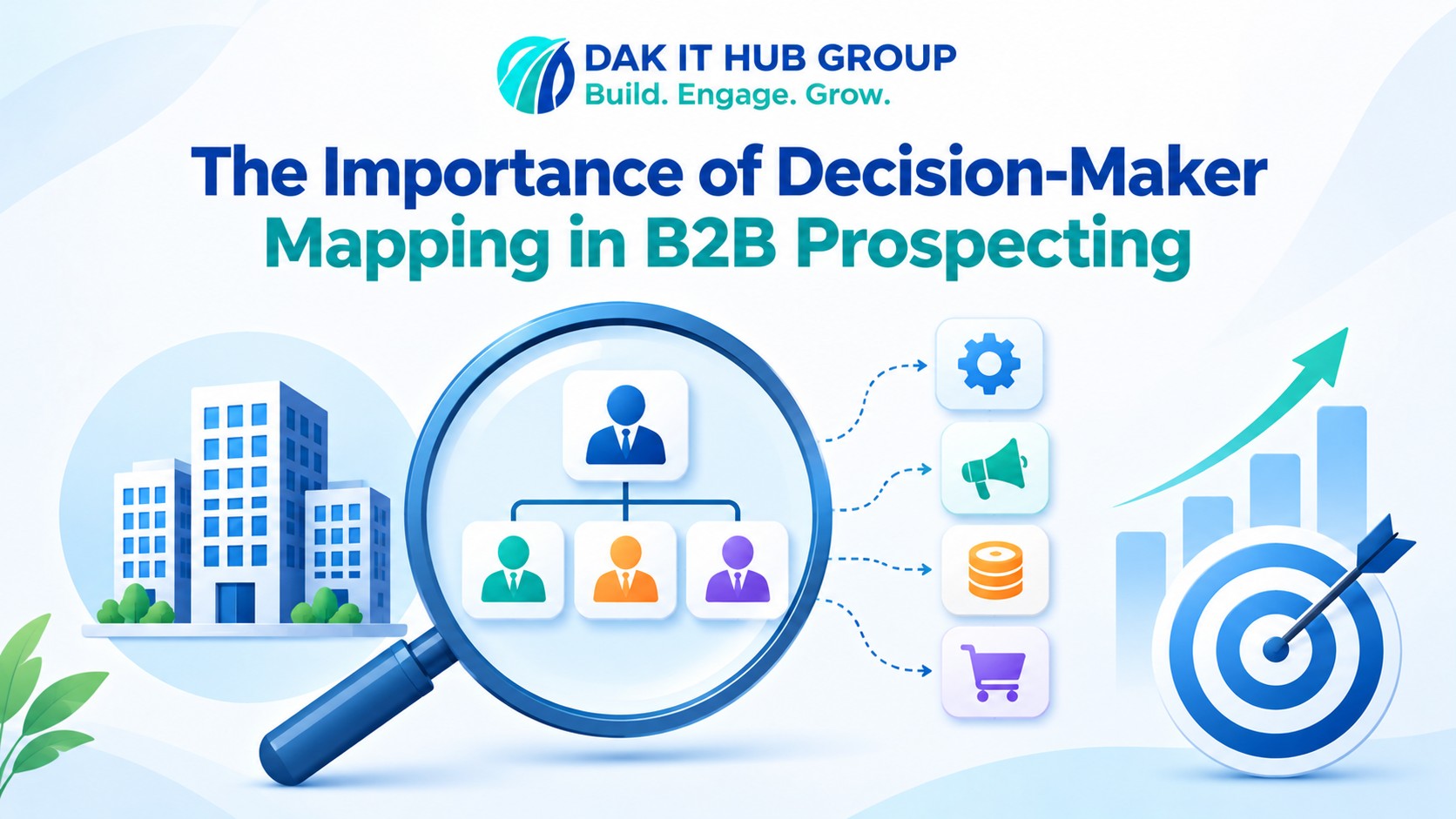
Successful B2B prospecting is not simply about identifying companies that could benefit from a product or service. It is equally important to identify the right individuals within those organizations who influence, evaluate, recommend, and approve purchasing decisions. Even when a business has a genuine requirement, reaching the wrong contact can delay conversations, reduce engagement, and result in missed sales opportunities.
In complex B2B sales environments, purchasing decisions rarely depend on a single individual. A technology investment, outsourcing agreement, marketing service, or enterprise software purchase may involve department heads, senior executives, technical evaluators, procurement professionals, and financial decision-makers. Each stakeholder has different responsibilities and priorities, making it essential for sales and marketing teams to understand the organizational buying structure before initiating outreach.
This is where decision-maker mapping becomes an important part of B2B prospecting. It helps businesses identify the right people within target accounts, understand their roles in the purchasing process, and develop a structured approach to engaging relevant stakeholders.
By combining accurate contact discovery with decision-maker mapping, B2B organizations can improve prospecting efficiency, strengthen outreach relevance, and build better-qualified sales pipelines.
What Is Decision-Maker Mapping in B2B Prospecting?
Decision-maker mapping is the process of identifying and organizing the individuals who participate in purchasing decisions within a target organization.
It involves understanding the company’s organizational structure, identifying relevant departments, locating key stakeholders, and determining how each person contributes to the buying process.
A typical B2B purchasing group may include:
- Economic decision-makers: Senior executives or budget owners who approve investments and control financial resources.
- Technical decision-makers: IT leaders, technical managers, or specialists who evaluate compatibility, security, functionality, and implementation requirements.
- Business decision-makers: Department heads and functional leaders who identify business requirements and evaluate potential solutions.
- Influencers: Professionals who research solutions, recommend vendors, and provide internal opinions.
- Procurement professionals: Individuals responsible for vendor evaluation, commercial negotiations, purchasing policies, and contract processes.
- End users: Employees who will ultimately use the product or service and can influence adoption decisions.
Identifying these stakeholders provides a more complete picture of the buying process and helps sales teams avoid depending on a single contact who may not have the authority or influence to move an opportunity forward.
1. Reaching the Right Contacts Improves Prospecting Efficiency
One of the most common challenges in B2B prospecting is reaching individuals who are not directly involved in the purchasing decision.
For example, a company offering cybersecurity solutions may contact a general administrative employee instead of the IT director, Chief Information Security Officer, or relevant technology leadership team. Although the company may match the ideal customer profile, the outreach is unlikely to generate meaningful sales discussions if it does not reach the appropriate stakeholders.
Decision-maker mapping helps prevent this problem by connecting the proposed solution with the individuals responsible for the relevant business function.
Before launching an outreach campaign, sales teams should identify:
- The department most likely to require the solution.
- The seniority level responsible for evaluating the requirement.
- The individual who controls or influences purchasing decisions.
- Other stakeholders who may participate in vendor selection.
- Relevant contact information and preferred professional communication channels.
This preparation reduces unnecessary outreach and allows sales professionals to concentrate on contacts who are more likely to contribute to a business conversation.
2. Understanding the Organizational Buying Structure
Different organizations follow different purchasing processes. A small business may allow a department head to approve a service independently, while a large enterprise may require approval from several departments and senior executives.
Understanding this structure is essential when developing a prospecting strategy.
For instance, purchasing a marketing automation platform may involve:
- The Chief Marketing Officer, who defines strategic requirements.
- The Marketing Operations Director, who evaluates operational capabilities.
- The IT Director, who assesses integration and security.
- The Finance Manager, who reviews investment requirements.
- The Procurement Manager, who handles vendor selection and commercial terms.
A prospecting campaign that targets only the marketing department may overlook important stakeholders who influence the final decision.
By mapping the buying group, businesses can develop a coordinated outreach strategy that considers the responsibilities and priorities of each participant.
3. Improving Outreach Personalization and Relevance
Generic B2B outreach often struggles to capture attention because it does not address the recipient’s specific responsibilities or business challenges.
Decision-maker mapping provides the information needed to create more relevant communication.
For example, a company offering data management services could approach different stakeholders with different value propositions:
- CIOs and IT leaders: Focus on data infrastructure, integration, security, and operational efficiency.
- Marketing leaders: Highlight audience intelligence, campaign performance, and customer data quality.
- Sales leaders: Emphasize accurate prospect information, improved targeting, and sales productivity.
- Procurement professionals: Address service scope, vendor reliability, compliance, and commercial considerations.
The underlying service may be the same, but the messaging should reflect what matters to each recipient.
This approach makes email marketing and telemarketing more meaningful because conversations begin with business-relevant topics rather than generic product introductions.
4. Reducing Dependency on a Single Contact
Relying on one contact within a target account can create unnecessary risk for a sales opportunity.
The individual may leave the company, change responsibilities, lack purchasing authority, or simply be unable to influence the decision. If the sales team has no visibility into other relevant stakeholders, the opportunity may stall.
Decision-maker mapping helps establish broader account coverage by identifying multiple relevant contacts across departments and seniority levels.
This does not mean contacting every employee within an organization. Instead, it means identifying a suitable group of stakeholders whose responsibilities are connected to the purchasing decision.
A structured approach can help sales teams:
- Identify alternative contacts within the same department.
- Locate senior professionals who influence strategic decisions.
- Engage technical and operational evaluators.
- Understand relationships between different stakeholders.
- Maintain continuity when a primary contact becomes unavailable.
This is particularly valuable in enterprise prospecting, where purchasing decisions can involve lengthy evaluation and approval processes.
5. Supporting Account-Based Marketing and Targeted Campaigns
Decision-maker mapping plays an important role in Account-Based Marketing (ABM), where marketing and sales teams concentrate their efforts on selected high-value organizations.
ABM requires more than identifying a list of target companies. Businesses must also understand who they need to engage within each account.
For example, a company targeting 100 enterprise organizations may identify five relevant stakeholders within each account. These could include a business leader, department head, technical evaluator, financial decision-maker, and procurement professional.
This information can support coordinated campaigns involving:
- Persona-specific email marketing.
- Targeted content distribution.
- Personalized outreach sequences.
- Telemarketing and appointment-setting activities.
- Relevant follow-ups based on stakeholder interests.
- Account-level engagement tracking.
By mapping the buying group before launching campaigns, businesses can improve audience selection and coordinate communication across multiple relevant contacts.
6. Improving Lead Quality Through Accurate Contact Discovery
Decision-maker mapping is only effective when the underlying contact information is accurate and relevant.
Outdated job titles, incorrect email addresses, duplicate records, and incomplete company information can reduce campaign effectiveness and waste sales resources.
A reliable contact discovery process should validate important information such as:
- Full name and current professional designation.
- Company name and business location.
- Department and functional responsibility.
- Professional email address.
- Relevant business contact details.
- Seniority and potential decision-making influence.
Contact information should be verified periodically because employees change roles, move between organizations, and assume new responsibilities.
Businesses should also follow applicable data protection, privacy, and electronic communication requirements when collecting and using professional contact information.
Accurate contact discovery combined with decision-maker mapping helps ensure that outreach is directed toward relevant professionals with a genuine connection to the offering.
7. Measuring the Effectiveness of Decision-Maker Mapping
To understand whether decision-maker mapping is improving prospecting performance, businesses should monitor relevant operational and campaign metrics.
Some useful indicators include:
| Metric | What it measures |
| Contact accuracy | Reliability of discovered contact information |
| Stakeholder coverage | Number of relevant buying-group roles mapped |
| Email engagement | Responses and meaningful interactions from targeted contacts |
| Connection rate | Successful connections through telemarketing |
| Qualification rate | Percentage of contacts meeting agreed prospect criteria |
| Meeting conversion | Relevant meetings generated from outreach |
| Sales acceptance | Leads accepted by the sales team for further engagement |
These measurements help organizations identify gaps in their contact discovery and prospecting processes.
For example, a high contact volume combined with low engagement may indicate that the wrong stakeholders are being targeted. Similarly, strong engagement but limited meeting conversion may suggest that messaging, qualification, or follow-up processes need improvement.
Regularly reviewing these metrics allows marketing and sales teams to refine their targeting strategies and improve campaign performance over time.
Conclusion
Decision-maker mapping is a fundamental component of effective B2B prospecting because it helps businesses understand who influences purchasing decisions within their target organizations. By identifying economic buyers, technical evaluators, business leaders, procurement professionals, and other relevant stakeholders, sales teams can develop more focused outreach strategies and reduce dependency on individual contacts. When supported by accurate contact discovery, personalized communication, and structured account research, decision-maker mapping helps improve prospecting efficiency, strengthen account coverage, and create better opportunities for meaningful sales engagement.
DAK IT HUB GROUP helps businesses strengthen their B2B prospecting efforts through its B2B Contact Discovery services. Our services focus on finding the right-party contacts within target organizations, helping businesses identify relevant decision-makers, department heads, senior executives, and other key stakeholders for outreach and lead generation. By supporting contact discovery with relevant business information and accurate prospect targeting, DAK IT HUB GROUP helps sales and marketing teams reach the right people, improve outreach effectiveness, and build a stronger foundation for B2B lead generation.
0 Comments