
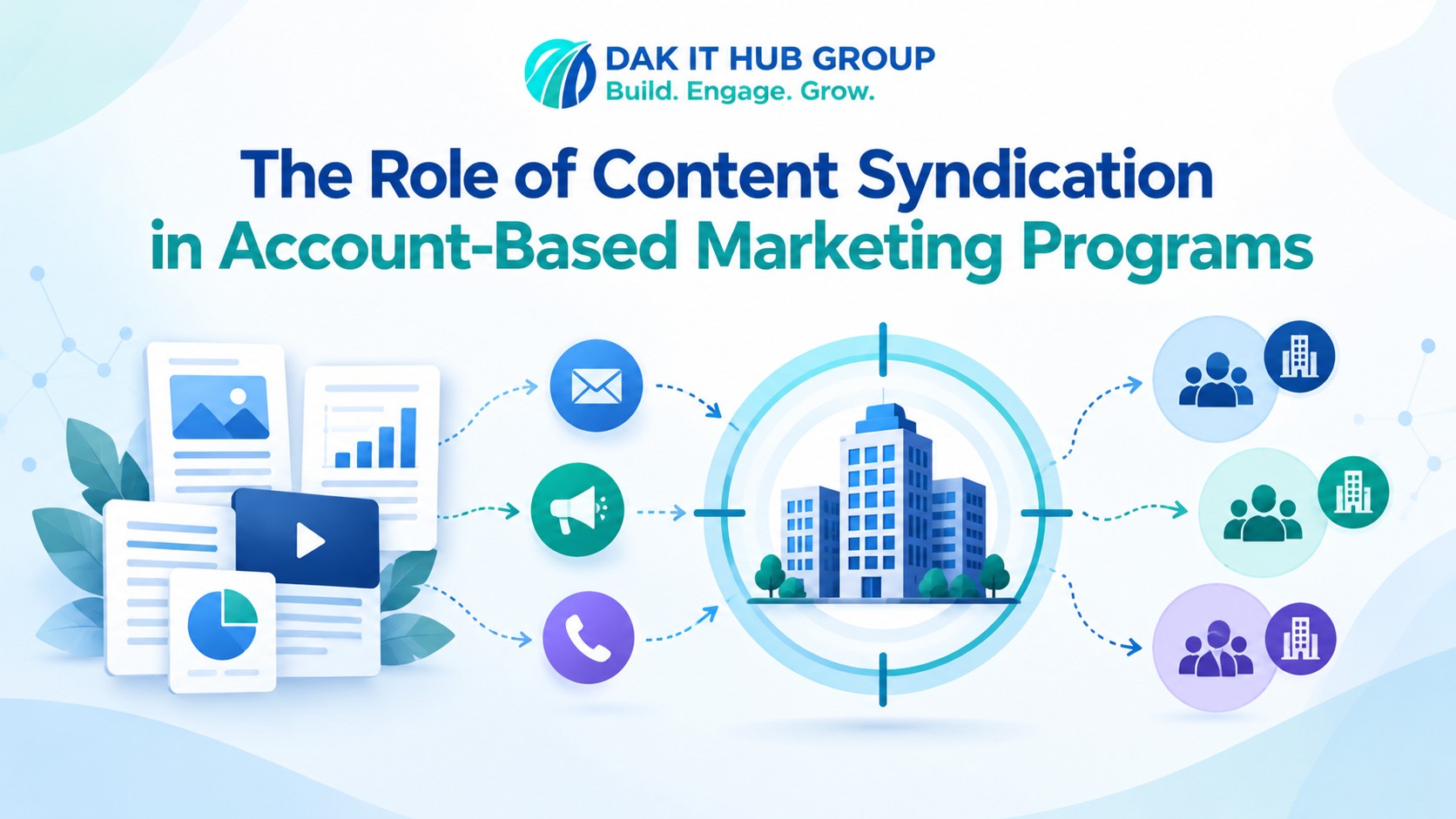
Account-Based Marketing (ABM) has become an important strategy for B2B organizations seeking to engage high-value accounts with personalized, coordinated marketing campaigns. Rather than targeting a broad audience and hoping to generate relevant leads, ABM focuses resources on specific companies that match an organization’s ideal customer profile. This approach enables sales and marketing teams to align their efforts, deliver relevant messaging, and build relationships with decision-makers who influence purchasing decisions.
However, even well-designed ABM programs face a common challenge: reaching the right stakeholders consistently and providing them with content that addresses their business priorities. Decision-makers may work across different departments, consume information through different channels, and progress through the buying journey at different speeds.
Content syndication helps address this challenge by distributing relevant content through external publishing platforms and specialized audience networks to reach prospects beyond a company’s owned channels. When integrated with ABM, content syndication can help businesses increase visibility among target accounts, engage multiple stakeholders, and identify potential buying interest.
The key is to treat content syndication as a strategic account engagement tactic rather than simply a method of generating large volumes of leads.
Understanding Content Syndication in ABM
Content syndication involves distributing existing marketing assets—such as whitepapers, research reports, e-books, case studies, webinars, and industry guides—through third-party channels to reach relevant audiences.
In an ABM program, the distribution strategy is guided by a predefined list of target accounts and the people within those organizations who influence purchasing decisions.
For example, a software company targeting enterprise organizations may want to reach Chief Information Officers, IT directors, security leaders, and procurement professionals. By syndicating relevant content through suitable channels, the company can introduce its expertise to these stakeholders and encourage engagement with topics connected to its solutions.
Unlike broad lead generation campaigns, ABM-oriented content syndication prioritizes account relevance, audience fit, stakeholder coverage, and the quality of engagement.
The objective is not simply to collect contact details. It is to create meaningful opportunities to engage the organizations that matter most to the business.
1. Align Content Syndication With Target Account Selection
The success of an ABM program begins with selecting the right accounts. Before distributing content, marketing teams should define which companies represent the greatest potential value and why those companies are a priority.
Account selection typically considers factors such as:
- Industry and company size: Focus on organizations that match the business’s ideal customer profile.
- Geographic location: Prioritize markets where the company can effectively deliver its products or services.
- Technology environment: Identify companies whose existing systems or infrastructure align with the proposed solution.
- Business priorities: Look for expansion plans, operational challenges, or initiatives relevant to the offering.
- Buying group structure: Identify the departments and job roles likely to influence the purchasing decision.
Once the target account list is established, content syndication campaigns can be configured to reach relevant professionals within those organizations. This makes content distribution more focused and gives marketing teams a clearer way to assess whether engagement comes from strategically important accounts.
2. Match Content to Buyer Personas and Their Challenges
Different stakeholders within the same company have different priorities. A Chief Information Officer may focus on strategic value and technology risk, while an IT manager may be more concerned with implementation, integration, and operational efficiency. A finance executive may want to understand costs, return on investment, and financial impact.
Using the same content asset for every stakeholder can limit engagement. Instead, businesses should select content according to the challenges and responsibilities of each buyer persona.
Consider an ABM campaign targeting enterprise companies evaluating cybersecurity solutions.
- Senior executives: Business risk reports and strategic security assessments.
- IT and security leaders: Technical guides, implementation frameworks, and threat analysis.
- Finance stakeholders: Cost-benefit assessments and investment justification resources.
- Procurement professionals: Vendor evaluation frameworks and comparison guides.
Content syndication enables these assets to reach relevant audiences through external distribution channels. When the content addresses a genuine business challenge, engagement can provide useful context for subsequent marketing and sales conversations.
The objective is to deliver relevant information that helps stakeholders evaluate their options rather than simply encouraging them to download a document.
3. Use Email Marketing to Nurture Syndicated Content Leads
Content syndication can introduce a brand to prospects who may not have previously interacted with its website or marketing channels. However, an initial content download rarely provides enough information to establish sales readiness.
Email marketing helps extend the relationship beyond that first interaction.
Once a prospect has engaged with syndicated content and can appropriately be contacted under applicable consent and privacy requirements, businesses can develop a relevant follow-up sequence.
A practical nurture sequence might include:
1. Initial follow-up: Share the requested resource and provide additional context about the subject.
2. Educational email: Offer a related industry insight, research finding, or practical guide.
3. Problem-focused email: Explain how organizations address the challenge covered in the original content.
4. Solution-oriented email: Introduce a relevant approach, framework, or service.
5. Next-step email: Invite the prospect to discuss the topic, attend a webinar, or explore a suitable solution.
The sequence should reflect the prospect’s role, account priority, and demonstrated interests. A technical stakeholder who downloads an implementation guide should receive different follow-up content from a senior executive who engages with a business strategy report.
Email engagement can inform further prioritization, but opens and clicks alone should not be treated as definitive buying intent. Marketers should evaluate engagement alongside account fit, role relevance, repeated interactions, and other available signals.
4. Coordinate Content Syndication With Telemarketing
While email marketing supports ongoing engagement, telemarketing can provide direct conversations that help establish the context behind a prospect’s interest.
For ABM campaigns, telemarketing is most effective when it complements content distribution rather than operating as an unrelated outreach activity.
For example, a prospect from a target account may download a report about improving sales productivity. A well-prepared caller can use the report’s subject as a natural starting point to explore the organization’s current processes, challenges, and priorities.
These conversations can help establish:
- Whether the prospect’s organization faces the problem addressed by the content.
- Which departments or stakeholders are involved in evaluating solutions.
- Whether the initiative is an active priority or an early research exercise.
- What additional information the prospect needs.
- Whether a relevant follow-up conversation would be useful.
The approach should remain consultative. A content download does not automatically mean the prospect wants an immediate sales call, so outreach should respect the prospect’s preferences and applicable communication requirements.
When email marketing and telemarketing work together, marketing teams can provide educational information while direct conversations help validate requirements and determine the most appropriate next step.
5. Reach Multiple Stakeholders Within the Same Account
B2B purchases frequently involve several stakeholders who evaluate different aspects of a potential investment. Engaging only one contact may leave important decision-makers and influencers outside the conversation.
Content syndication can help expand account coverage by distributing relevant content to multiple roles within a target organization.
For example, a company selling enterprise software might engage an IT director through a technical guide, a finance leader through an investment assessment, and an operations executive through a process improvement report.
Each interaction provides a different perspective on the account’s priorities. When these engagements are reviewed together, marketing and sales teams can build a more complete understanding of the organization’s interests.
However, multiple downloads do not automatically indicate a purchase is imminent. Teams should assess the relevance of the contacts, the subject matter, the account’s overall fit, and any additional qualification information.
The objective is to build meaningful engagement across the buying group rather than maximize the number of contacts collected from each company.
6. Establish Lead Qualification and Sales Handoff Rules
An effective ABM content syndication program requires clear agreement between marketing and sales on what constitutes a valuable lead.
Without agreed qualification criteria, marketing may focus on generating content downloads while sales expects immediate purchasing opportunities. This mismatch can undermine confidence in the campaign.
Before launching, teams should define the qualification and handoff process.
| Qualification factor | What to evaluate |
| Account fit | Does the company match the ideal customer profile or target account list? |
| Contact relevance | Does the person’s role align with the buying group? |
| Content engagement | Is the content relevant to the account’s likely business challenges? |
| Data quality | Are contact details accurate, appropriately sourced, and usable? |
| Buying signals | Is there additional evidence of an active requirement or initiative? |
| Follow-up readiness | Should the contact enter nurture, receive qualification outreach, or be referred to sales? |
Not every syndicated lead needs to be sales-ready. Some contacts may be appropriate for ongoing nurture, while others may warrant further qualification or direct sales engagement.
Marketing should provide useful context with each lead, including the content consumed, account information, relevant qualification findings, and recommended next step. Sales feedback should then inform subsequent campaign targeting and content choices.
7. Measure Account Engagement, Not Just Lead Volume
Traditional lead generation metrics, such as total leads and cost per lead, can provide useful operational information. However, they do not fully capture the contribution of content syndication to ABM.
A stronger measurement framework considers both lead-level quality and account-level progress.
Important metrics include:
- Target account reach: The number or percentage of priority accounts reached.
- Account match rate: The proportion of generated contacts associated with target or ideal-profile accounts.
- Stakeholder coverage: The number of relevant buying group roles engaged within target accounts.
- Content engagement: The performance of different assets across account segments and personas.
- Lead qualification rate: The proportion of leads meeting agreed qualification requirements.
- Sales acceptance rate: The percentage of leads accepted for follow-up by the sales team.
- Meeting creation: Relevant meetings generated from campaign engagement.
- Pipeline contribution: Opportunities created or influenced by the program, using a clearly defined attribution approach.
These metrics help teams identify where improvement is needed. If a campaign produces many leads but few target-account matches, the targeting strategy may need adjustment. If account fit is strong but sales acceptance is weak, qualification criteria or follow-up processes may require attention.
Measurement should ultimately help marketing and sales make better decisions about where to invest resources next.
Conclusion
Content syndication can play an important role in account-based marketing by extending the reach of relevant content, engaging stakeholders within target accounts, and creating useful signals for subsequent marketing and sales activity. Its effectiveness depends on selecting the right accounts, matching content to buyer personas, nurturing engagement through email marketing, coordinating appropriate telemarketing outreach, and measuring account-level progress rather than focusing exclusively on lead volume.
DAK IT HUB GROUP helps businesses strengthen their B2B email marketing and content syndication programs by combining targeted email marketing with telemarketing. Our B2B email marketing services support the distribution of relevant content to appropriate business audiences, while telemarketing helps qualify prospect interest and gather additional context through direct conversations. By integrating these activities with account-focused targeting and lead qualification, DAK IT HUB GROUP helps businesses reach relevant prospects, improve engagement with target accounts, and support more effective account-based marketing programs.

0 Comments