
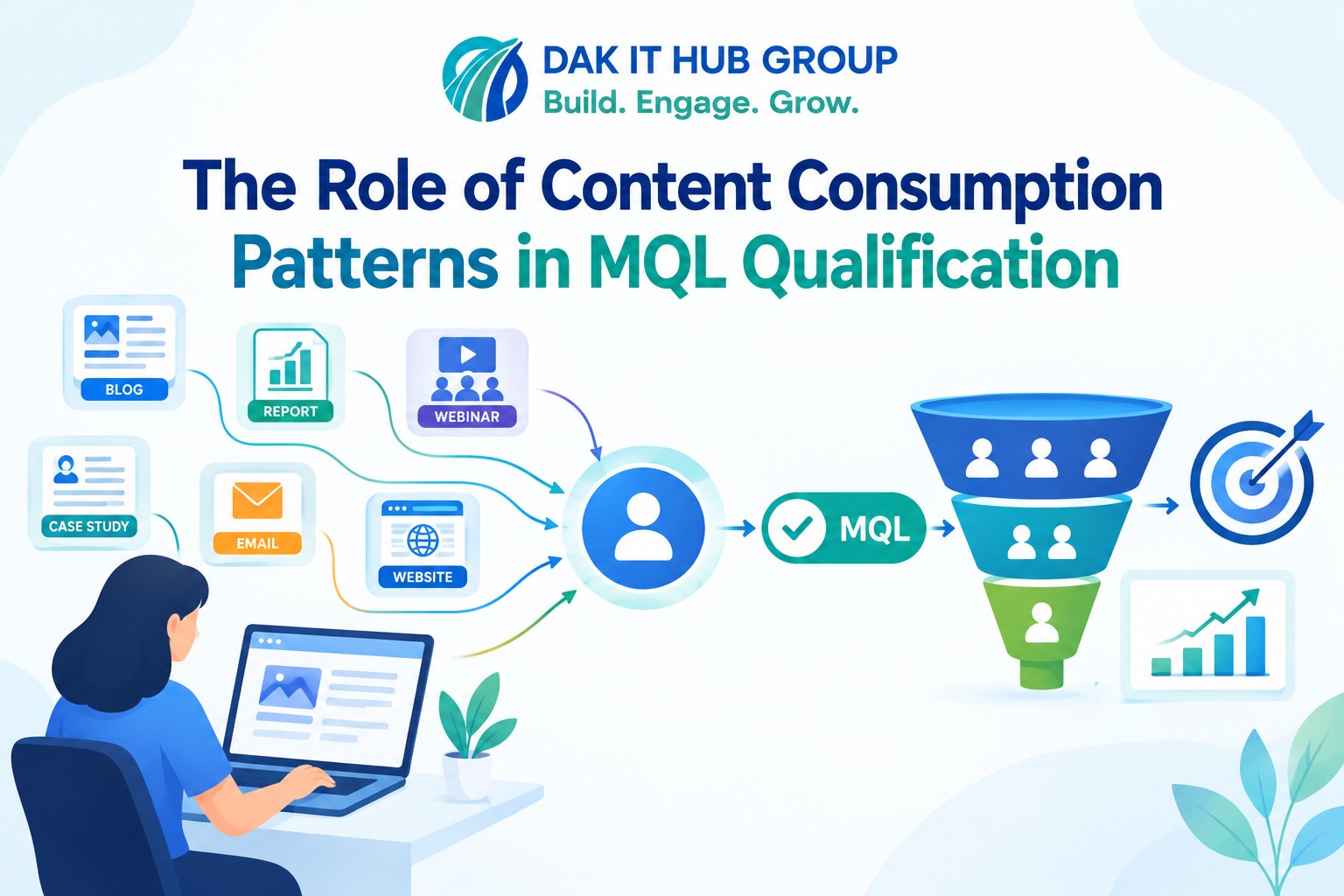
Generating large numbers of leads is not enough for modern B2B marketing teams. The bigger challenge is determining which prospects have demonstrated meaningful interest and are worth progressing through the funnel.
This is where content consumption patterns can play an important role in MQL qualification. What a prospect reads, downloads, watches, revisits, and engages with can provide useful behavioral context. However, no individual content interaction should automatically make someone a Marketing Qualified Lead (MQL). The real value comes from understanding the pattern, relevance, frequency and recency of engagement alongside the prospect’s business profile.
An MQL generally represents a prospect whose characteristics and marketing behavior indicate enough potential interest to warrant further nurturing or sales consideration. Behavioral signals such as website activity, content engagement and email interactions can contribute to this assessment. ([LinkedIn Business Solutions])
Why Content Consumption Matters in MQL Qualification
B2B buyers often conduct substantial research before speaking with a sales representative. During this research process, they may interact with multiple types of content.
For example, a prospect might:
- Read several educational blog posts
- Download an industry report
- Watch a product webinar
- Read a case study
- Visit product or solution pages
- Download a comparison guide
- Click links in nurture emails
Individually, these actions may not provide enough information to qualify the prospect. Together, however, they can reveal a more meaningful engagement pattern.
A prospect repeatedly consuming content related to a specific business challenge may be demonstrating a stronger signal than someone who downloads one general-purpose ebook and never engages again.
Not All Content Signals Have the Same Value
One of the most important considerations in content-based MQL qualification is content intent.
Different assets can indicate different stages of the buyer journey.
For example, a general educational blog post may indicate early research. An industry report may indicate deeper interest in a particular topic. A case study can suggest that the prospect is exploring how other organizations addressed a problem. A product comparison, pricing-related resource or solution-specific webinar may indicate that the prospect has moved further into evaluation.
This does not mean that one type of content should automatically qualify or disqualify a lead. Instead, marketers should consider the content consumed within the broader context of the prospect’s profile and journey. Current B2B lead-scoring approaches increasingly distinguish basic engagement from signals that more closely resemble buying intent.
Look for Patterns, Not Isolated Actions
A common mistake is assigning too much importance to a single activity.
For example:
One ebook download ≠ automatically an MQL
But consider a different sequence:
Blog article → industry report → webinar → case study → solution page
That sequence provides considerably more context.
The prospect is not simply interacting with content. They are moving through different information types and potentially becoming more focused on a particular business problem or solution.
Lead scoring can therefore incorporate multiple behavioral dimensions, including engagement frequency, content type, website activity and recency.
Content Topic Is Often More Important Than Content Volume
A prospect’s content topic preferences can be particularly valuable.
Imagine a technology company publishes articles about cloud security, data protection, IT modernization and general technology trends. A prospect consumes five pieces of general technology content but never interacts with cloud security material.
Another prospect consumes only three pieces of content, but all three relate specifically to cloud security and include a detailed webinar and case study.
Simply counting content interactions could make the first prospect appear more engaged. Looking at topic relevance, however, provides additional context about what the second prospect may actually be researching.
This is why MQL qualification should consider both engagement depth and engagement relevance.
Recency Can Change the Meaning of Engagement
Content consumption also needs to be evaluated over time.
A prospect who downloaded a whitepaper eighteen months ago may still be a good fit for the business, but that historical activity should not necessarily carry the same weight as recent engagement.
On the other hand, a prospect who has interacted with several relevant assets during the past few weeks may warrant greater attention.
Recency, frequency and progression can therefore be incorporated into lead-scoring models rather than treating every historical activity equally. Modern scoring frameworks increasingly separate fit from behavioral engagement and account for the timing of signals.
Combine Content Behavior With ICP Fit
Content consumption alone should not determine MQL status.
A prospect may consume extensive content simply because they are researching a subject, writing an article, evaluating the industry or performing academic research.
That is why behavioral signals should be combined with Ideal Customer Profile (ICP) fit.
Relevant criteria may include:
- Industry
- Company size
- Geography
- Job function
- Seniority
- Business model
- Technology environment
- Potential business need
This creates a more balanced qualification model.
A highly engaged contact from outside the company’s target market may not be as valuable as a moderately engaged contact who matches the ICP closely and demonstrates relevant behavior.
Build a Content-Based Lead Scoring Model
Businesses can translate content consumption patterns into a structured scoring framework.
For example, marketers might assign different weights to:
Top-of-funnel content: Blog posts, newsletters and general educational resources.
Mid-funnel content: Webinars, industry reports, templates and detailed guides.
Bottom-funnel content: Case studies, solution comparisons, product-focused resources and pricing-related content.
Additional scoring factors can include repeated engagement, multiple sessions, email clicks and recent activity.
The exact scoring model should be based on the organization’s own buyer journey rather than arbitrary numbers. Marketing and sales should agree on what combination of fit and behavioral signals qualifies a prospect as an MQL.
Connect Content Signals With Human Qualification
Digital behavior provides useful context, but it does not always explain why a prospect is engaging.
This is where human follow-up can add another layer of qualification.
For example, a prospect who repeatedly engages with content about a particular solution may be contacted to understand whether there is an active business requirement. A telemarketing conversation can help establish whether the topic is genuinely relevant, whether the prospect is involved in the buying process and whether there is an opportunity worth nurturing.
The objective is not to assume that content engagement proves purchase intent. Instead, content behavior can help identify where further qualification may be appropriate.
Continuously Refine the MQL Model
MQL qualification should evolve as businesses learn which signals actually contribute to sales outcomes.
Marketing teams can review historical MQLs and compare their content behavior with subsequent outcomes. Which content combinations were common among leads that progressed? Which activities produced high engagement but little sales progression? Which topics generated conversations?
These insights can help refine scoring criteria, content strategy and campaign targeting.
The result is a more evidence-based approach to MQL qualification—one that focuses less on raw activity counts and more on meaningful engagement patterns.
Final Thoughts
Content consumption patterns can provide valuable behavioral context for MQL lead generation, but they should be treated as signals rather than automatic proof of buying readiness. The strongest qualification models combine content relevance, engagement frequency, recency and progression with ICP fit and, where appropriate, human validation. DAK IT HUB GROUP’s B2B lead generation services help businesses generate and develop MQLs through targeted email marketing and telemarketing. By reaching relevant prospects, promoting useful content, tracking engagement and using telemarketing to further understand prospect interest and requirements, DAK IT HUB GROUP helps sales and marketing teams build a more consistent flow of qualified B2B leads.

0 Comments