
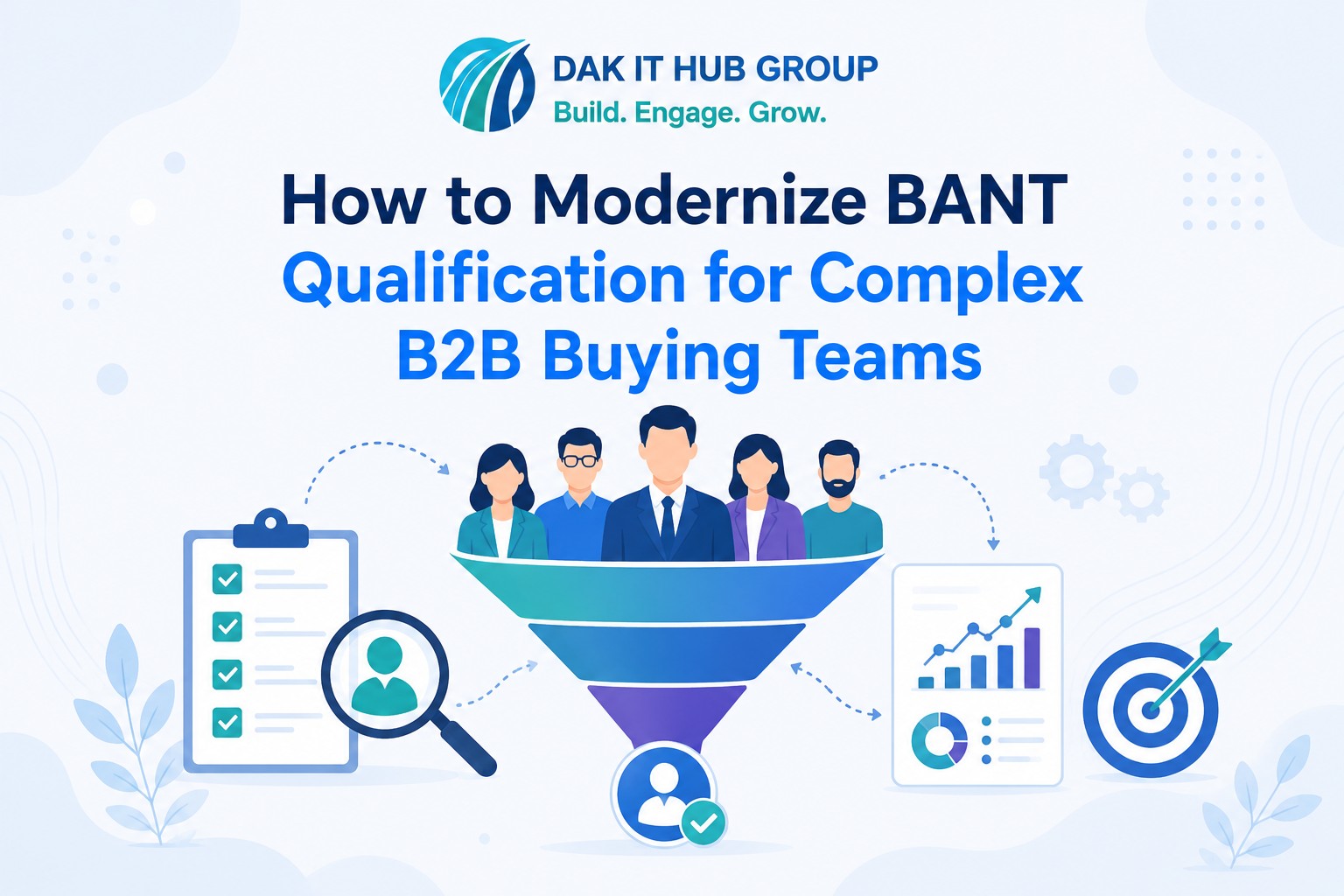
BANT has been one of the most trusted lead qualification frameworks in B2B sales for decades. Standing for Budget, Authority, Need, and Timeline, it helps sales and marketing teams determine whether a prospect is ready to move forward in the buying process. While the core principles of BANT remain valuable, today’s B2B buying journey has become much more complex.
Modern buying decisions often involve multiple stakeholders, longer sales cycles, and extensive online research before prospects ever speak to a salesperson. Because of these changes, businesses need to modernize how they use BANT to identify and qualify leads effectively.
In this blog, we’ll explore how organizations can adapt the BANT framework to meet the demands of today’s complex B2B buying teams and improve lead qualification outcomes.
Why Traditional BANT Needs an Update
Years ago, B2B buying decisions were often made by one or two individuals. Sales representatives could quickly identify the budget holder, understand the need, and close deals relatively fast.
Today, things are different.
A typical B2B purchase may involve decision-makers from multiple departments, including finance, IT, procurement, operations, and senior leadership. Each stakeholder has different priorities, concerns, and expectations.
This means sales teams must look beyond simple qualification questions and understand the entire buying committee.
Modernizing BANT helps businesses qualify opportunities more accurately while building stronger relationships with every stakeholder involved.
Expand the Meaning of Authority
Traditionally, “Authority” focused on identifying the final decision-maker.
However, in today’s B2B environment, purchasing decisions rarely depend on one individual.
Instead, businesses should identify:
- Economic buyers
- Technical evaluators
- Department managers
- Procurement teams
- End users
- Executive sponsors
Each person influences the buying decision in different ways.
Rather than asking, “Who makes the final decision?” sales teams should ask questions such as:
- Who will use this solution?
- Who approves the budget?
- Who evaluates vendors?
- Who will be involved during implementation?
Understanding the complete buying team creates better qualification and reduces surprises later in the sales cycle.
Focus on Business Value Instead of Budget Alone
Budget remains important, but modern buyers often secure funding after proving business value.
Instead of immediately asking about available budgets, sales representatives should first understand:
- Business objectives
- Operational challenges
- Expected outcomes
- Return on investment
When buyers clearly understand the value of a solution, budget discussions become much easier.
Questions like these can guide the conversation:
- What business goals are you trying to achieve?
- What problems are costing your organization the most?
- What would success look like?
These discussions position your solution as an investment rather than simply an expense.
Dig Deeper into Business Needs
Modern buyers expect consultative conversations instead of scripted qualification.
Rather than asking surface-level questions, sales teams should explore:
- Current business processes
- Existing challenges
- Future growth plans
- Internal priorities
- Competitive pressures
The more sales professionals understand the prospect’s situation, the easier it becomes to recommend relevant solutions.
This approach also builds trust and credibility.
Understand the Buying Timeline
Today’s buying timelines are often influenced by several factors beyond urgency.
These may include:
- Budget approval cycles
- Contract renewals
- Digital transformation initiatives
- Internal projects
- Compliance deadlines
Instead of asking only, “When do you plan to buy?” sales teams should understand what events are driving the timeline.
Questions like these provide better insights:
- Is there a specific business event driving this project?
- What milestones need to happen before implementation?
- Are there internal approvals still required?
This helps forecast opportunities more accurately.
Use Behavioral Data Alongside BANT
Modern B2B qualification should combine BANT with behavioral insights.
Behavioral data includes:
- Website visits
- Content downloads
- Webinar registrations
- Email engagement
- Product page visits
- Demo requests
These actions indicate buying interest and help prioritize leads.
For example, a prospect who has downloaded multiple case studies and attended two webinars is likely demonstrating stronger buying intent than someone who simply filled out a contact form.
Combining BANT with behavioral data creates more accurate lead qualification.
Align Sales and Marketing Teams
Successful BANT qualification requires close collaboration between sales and marketing.
Marketing teams often gather valuable information through:
- Landing pages
- Email campaigns
- Webinar registrations
- Content downloads
- Marketing automation platforms
This information should flow directly into the CRM so sales teams have complete visibility before making contact.
Regular meetings between sales and marketing help refine qualification criteria and improve lead quality.
Personalize Every Conversation
Modern buyers expect personalized interactions.
Sales teams should tailor conversations based on:
- Industry
- Company size
- Business goals
- Previous engagement
- Content interests
Instead of using generic sales scripts, personalize questions based on available data.
This creates stronger relationships and improves buyer confidence.
Continuously Review Qualification
BANT should not be viewed as a one-time activity.
Business priorities often change during long B2B sales cycles.
Budgets can increase, stakeholders may change, and project timelines may shift.
Sales teams should revisit BANT throughout the buying journey to ensure qualification information remains accurate.
This ongoing qualification process improves forecasting and helps identify risks before they impact deals.
Measure Qualification Success
Modern BANT strategies should be supported by measurable performance metrics.
Useful KPIs include:
- Marketing Qualified Lead (MQL) to Sales Qualified Lead (SQL) conversion rate
- Opportunity conversion rate
- Sales cycle length
- Win rate
- Pipeline velocity
- Average deal size
Regularly reviewing these metrics helps businesses refine their qualification process and improve sales performance over time.
Final Thoughts
BANT remains one of the most valuable frameworks for B2B lead qualification, but today’s buying environment requires a more flexible and customer-focused approach. By expanding the definition of authority, focusing on business value instead of budget alone, combining BANT with behavioral insights, personalizing conversations, and continuously reviewing qualification, businesses can better engage complex buying teams and improve conversion rates.
To support organizations in generating high-quality BANT-qualified leads, DAK IT HUB GROUP offers specialized B2B lead generation services that combine targeted email marketing and strategic telemarketing campaigns. Our experienced team helps businesses identify the right decision-makers, qualify prospects using modern BANT principles, and deliver sales-ready leads that strengthen pipelines, improve conversion rates, and accelerate business growth.
0 Comments