
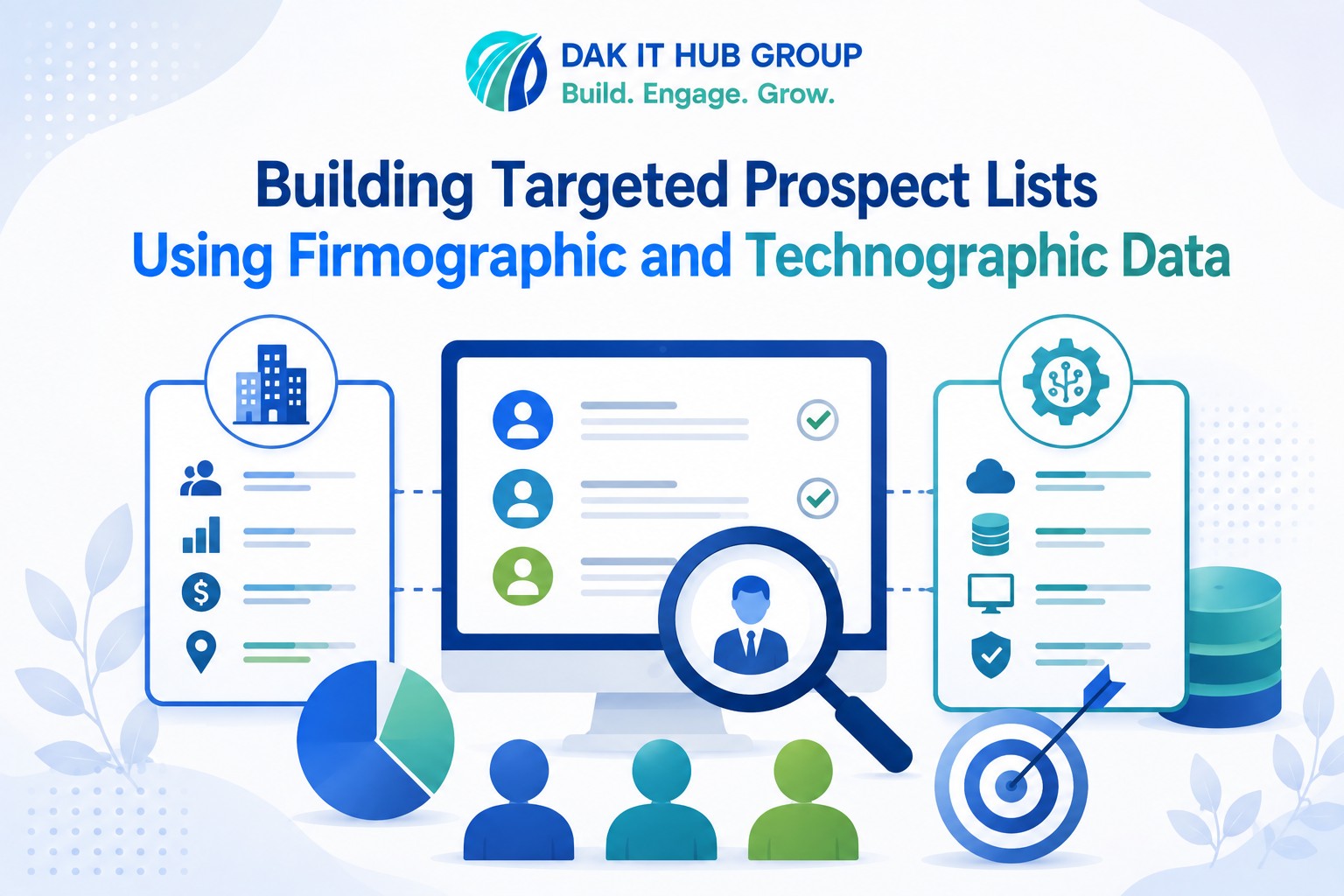
In B2B sales, having a large prospect database does not necessarily translate into better sales results. A list containing thousands of contacts may look impressive, but if those contacts do not belong to the right companies, use relevant technologies, or have a genuine business need, sales teams can spend significant time pursuing low-potential opportunities.
This is why B2B contact discovery increasingly depends on more than basic contact information. By combining firmographic and technographic data, businesses can build highly targeted prospect lists that align with their Ideal Customer Profile (ICP), sales strategy, and market objectives.
Firmographic data helps answer the question, “Which companies should we target?” Technographic data helps answer, “What technologies are those companies using?” When these datasets are combined with accurate contact research, sales and marketing teams can identify the organizations and decision-makers most likely to be relevant.
What Is Firmographic Data?
Firmographic data describes the characteristics of a business or organization. It is similar to demographic information used in B2C marketing, but it focuses on companies rather than individuals.
Common firmographic attributes include:
- Industry and sub-industry
- Company size
- Number of employees
- Annual revenue
- Headquarters location
- Geographic markets
- Company ownership
- Business model
- Growth stage
- Department size
For example, a B2B software company selling enterprise cybersecurity solutions may define its target market as companies with 500+ employees operating in financial services, healthcare, and technology.
Firmographic filters allow marketers to narrow a broad business universe into a much more relevant group of accounts.
What Is Technographic Data?
Technographic data provides information about the technologies and software a company uses.
Depending on the prospecting objective, this may include:
- CRM platforms
- Marketing automation systems
- Cloud infrastructure
- Analytics platforms
- Advertising technologies
- Content management systems
- E-commerce platforms
- Cybersecurity solutions
- Communication and collaboration tools
Technographic information can be particularly valuable when a company’s existing technology environment influences whether it is likely to need a particular product or service.
For example, a company selling Salesforce integration services could prioritize businesses already using Salesforce but potentially requiring additional integration, implementation, or optimization support.
Why Combine Firmographic and Technographic Data?
Using firmographic data alone can identify companies that appear to fit an ICP. However, it may not reveal whether those organizations have the technological environment that makes them relevant prospects.
Technographic data adds another layer of qualification.
Consider a company that meets the following criteria:
- Industry: Financial services
- Company size: 1,000+ employees
- Location: United States
- Technology: Specific CRM platform
- Growth: Expanding sales organization
This profile provides considerably more context than simply knowing the company operates in financial services.
The combination can help sales teams focus on accounts with both the business characteristics and technology requirements associated with their offering.
Start With a Well-Defined ICP
Before building a prospect list, businesses should clearly define their Ideal Customer Profile.
An effective ICP should include both firmographic and technographic characteristics.
For example:
Firmographic criteria:
- 200–2,000 employees
- B2B technology companies
- North America and UK
- Established revenue base
- Growing sales and marketing teams
Technographic criteria:
- Uses a particular CRM
- Uses marketing automation
- Has an established sales technology stack
- Uses specific analytics or advertising platforms
The more clearly the ICP is defined, the easier it becomes to identify accounts worth researching.
Use Data to Identify Relevant Accounts
Once the ICP is established, the next step is account identification.
Rather than beginning with individual contacts, businesses can first identify companies that meet their target criteria. This account-first approach improves the quality of subsequent contact research.
Once suitable accounts have been identified, sales teams can search for relevant professionals within those organizations.
Target job functions may include:
- C-level executives
- Vice Presidents
- Directors
- Department heads
- Procurement professionals
- IT leaders
- Marketing leaders
- Sales leaders
The appropriate job titles will depend on the product, sales cycle, and buying committee.
Identify the Right Buying Committee
Modern B2B purchases rarely involve just one person.
A technology purchase, for example, may involve an executive sponsor, an IT stakeholder, a finance representative, a procurement team, and the eventual users of the solution.
Firmographic and technographic data can help identify the right organizations, but contact research is necessary to identify the people involved in the buying process.
Instead of creating a list containing one contact per company, businesses can build multi-contact account profiles that include several relevant stakeholders.
This creates greater coverage and reduces the risk of relying on a single contact who may not have decision-making authority.
Improve Contact Research Accuracy
Targeted prospecting is only effective when the underlying contact information is accurate.
A quality B2B contact research process should validate information such as:
- Full name
- Job title
- Company
- Business email address
- Business phone number
- LinkedIn or professional profile
- Location
- Relevant department
Data should also be reviewed periodically because professionals change positions, companies restructure, and technology environments evolve.
Accurate contact information reduces wasted outreach and improves the chances of connecting with the intended decision-makers.
Segment Prospect Lists for Better Outreach
A single prospect list should not necessarily receive identical messaging.
Businesses can segment their lists according to firmographic and technographic characteristics.
For example, prospects can be divided by:
- Industry
- Company size
- Geography
- Technology used
- Job function
- Seniority
- Business challenge
This allows sales and marketing teams to create more relevant messaging for each segment.
A technology-focused message can address the specific challenges associated with a prospect’s existing technology stack, while an executive-level message can focus more heavily on business outcomes.
Keep Prospect Data Fresh
B2B data changes continuously.
Employees move between organizations, job responsibilities change, companies adopt new technologies, and businesses enter or leave specific markets.
For this reason, prospect-list building should not be treated as a one-time activity.
Regular data verification and enrichment can help maintain list quality. Businesses should establish processes for reviewing outdated records and updating important company and contact information.
Fresh data improves campaign deliverability, sales productivity, and overall outreach efficiency.
Measure Prospect List Quality
The success of a prospect list should not be measured simply by the number of contacts it contains.
More meaningful indicators include:
- Percentage of contacts matching the ICP
- Contact accuracy rate
- Email deliverability
- Response rate
- Meeting-booking rate
- MQL and SQL conversion
- Opportunity creation
- Revenue generated
These metrics help businesses determine whether their targeting strategy is producing commercially valuable prospects.
Final Thoughts
Building a targeted B2B prospect list requires a strategic approach to data. Firmographic data helps businesses identify organizations that fit their ideal customer profile, while technographic data provides insight into the technologies and systems those organizations use. When combined with accurate contact research, these data points allow sales and marketing teams to move beyond generic prospecting and create highly relevant account and contact lists. The result is more focused outreach, better personalization, improved sales productivity, and a stronger foundation for B2B lead generation.
DAK IT HUB GROUP’s B2B contact discovery services help businesses strengthen their prospecting efforts through professional contact research. By researching target companies, identifying relevant decision-makers, and validating key contact and business information against defined targeting criteria, DAK IT HUB GROUP helps sales and marketing professionals build accurate, targeted prospect lists that support more effective B2B outreach and pipeline development.


0 Comments