
B2B lead generation has become increasingly complex. Buyers rarely move from seeing one message to immediately requesting a sales conversation. They may discover a company through email, engage with a content asset, visit its website, attend a webinar, speak with a representative and involve several other stakeholders before becoming sales-ready.
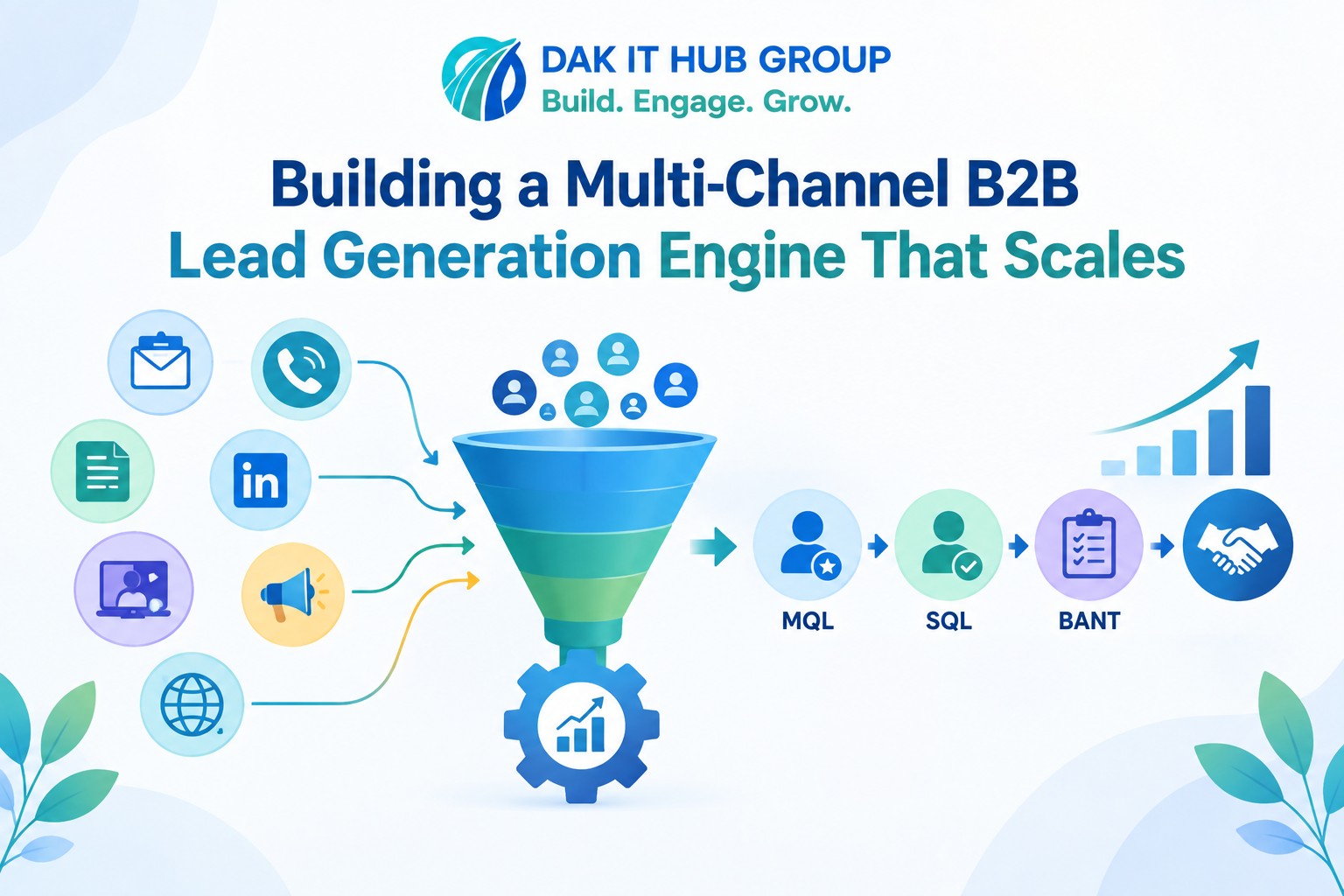
This is why successful B2B organizations are moving beyond isolated lead generation campaigns and building multi-channel B2B lead generation engines. Instead of depending on one source of leads, a scalable engine combines multiple channels, consistent messaging, accurate targeting, lead qualification and structured follow-up.
A multi-channel approach is not simply about using more channels. The real objective is to make different channels work together as one coordinated system.
Start With a Clearly Defined ICP
Every scalable lead generation engine should begin with a well-defined Ideal Customer Profile (ICP).
Your ICP should identify the types of companies most likely to benefit from your offering. Consider factors such as:
- Industry
- Company size
- Revenue range
- Geography
- Technology environment
- Business challenges
- Relevant departments
- Decision-making roles
Once the ICP is defined, prospecting becomes more focused. Instead of trying to reach thousands of businesses, marketing and sales teams can concentrate resources on accounts with a stronger potential fit.
This also improves downstream performance because messaging, content and qualification criteria can be built around a clearly defined audience.
Combine Multiple Lead Generation Channels
A scalable engine should not depend entirely on email, paid advertising, social media or any other individual channel.
Instead, businesses can combine channels such as:
Email marketing: Useful for targeted outbound campaigns, nurturing and communicating relevant content.
Telemarketing: Provides direct human interaction that can help identify interest, confirm requirements and qualify prospects.
Content marketing: Helps attract prospects researching problems and potential solutions.
Webinars and events: Create opportunities to engage prospects around specific business topics and capture relevant buying signals.
Social media: Helps build visibility and engage decision-makers throughout the buying journey.
The important factor is coordination. A prospect should not receive disconnected messages from different channels. Each interaction should contribute to the same overall buyer journey.
Build a Strong Data Foundation
Even the best messaging will struggle if the underlying prospect data is inaccurate.
A scalable lead generation engine needs reliable contact and company information. Before launching campaigns, businesses should verify important details such as:
- Company and industry
- Employee size
- Job title and seniority
- Business email address
- Location
- Relevant department
- Contact information
- Account-level fit
Data should also be regularly reviewed and updated. Poor-quality data can result in wasted outreach, irrelevant messaging and lower campaign efficiency.
Modern B2B lead generation increasingly emphasizes precise targeting and verified data rather than simply accumulating large contact databases.
Create One Coordinated Outreach Strategy
The biggest mistake with multi-channel lead generation is treating every channel as a separate campaign.
For example, a prospect might receive an email from marketing while simultaneously receiving an unrelated LinkedIn message and a phone call from another team. Instead of creating multiple touchpoints, this creates multiple disconnected experiences.
A better approach is to coordinate the sequence.
For example:
Touch 1: Targeted email introducing a relevant business problem
Touch 2: Follow-up email featuring useful content
Touch 3: Telemarketing call to understand interest and requirements
Touch 4: Additional email based on the conversation
Touch 5: Qualification and sales handoff where appropriate
This approach allows each interaction to build upon the previous one rather than repeating the same sales pitch.
Align MQL, SQL and BANT Criteria
Scalability requires more than generating leads. It requires a consistent method for determining which leads are worth pursuing.
An MQL (Marketing Qualified Lead) can represent a prospect that meets agreed marketing criteria based on fit and engagement. An SQL (Sales Qualified Lead) represents a prospect that has progressed far enough for sales engagement based on agreed qualification criteria. BANT—Budget, Authority, Need and Timeline—can then provide a structured framework for evaluating commercial readiness.
Importantly, MQL and SQL should not simply be treated as interchangeable labels. Marketing and sales should agree on the specific criteria required for a lead to move from one stage to another.
This alignment prevents a common problem: marketing reporting a high number of leads while sales receives contacts that are not actually ready for meaningful conversations.
Use Email Marketing for Scalable Reach
Email remains an important component of a multi-channel B2B lead generation engine because it allows organizations to reach specific audiences with targeted messaging at scale.
However, effective B2B email marketing should focus on relevance rather than simply increasing sending volume.
Strong campaigns typically include:
- Clearly defined target audiences
- Relevant messaging
- Concise value propositions
- Appropriate calls to action
- Multiple touches
- Segmentation
- Engagement-based follow-up
The objective is to start a relevant business conversation—not overwhelm prospects with promotional messages.
Add Telemarketing for Human Qualification
Email can create awareness and generate responses, but some qualification questions are easier to address through direct conversations.
Telemarketing can complement email campaigns by providing an opportunity to understand whether a prospect has a genuine business requirement. A well-structured call can help identify areas such as current challenges, solution requirements, decision-making involvement and potential timing.
This makes telemarketing particularly valuable when the objective goes beyond generating a contact and moves toward producing qualified MQLs, SQLs or BANT-qualified opportunities.
The key is to make calls part of the overall campaign rather than treating telemarketing as an unrelated activity.
Build a Nurturing Layer
Not every prospect will be ready to speak with sales immediately.
Some prospects may fit the ICP but have no immediate requirement. Others may be researching solutions without a defined project. A scalable engine needs a nurturing layer for these contacts.
Email content, educational resources, webinars, case studies and other relevant communications can keep prospects engaged until their requirements become more active.
This prevents businesses from treating every non-converting prospect as a lost lead.
Measure the Engine, Not Just Individual Campaigns
Scalable lead generation requires measurement across the entire funnel.
Instead of focusing only on email opens, clicks or raw lead volume, organizations should monitor metrics such as:
- Cost per MQL
- MQL-to-SQL conversion
- SQL-to-opportunity conversion
- BANT qualification rate
- Cost per qualified lead
- Meeting or conversation rate
- Pipeline generated
- Revenue influenced by each channel
These metrics help identify where the engine is performing and where improvements are required. A high volume of MQLs means little if very few become meaningful sales conversations.
Continuously Optimize the System
A lead generation engine should never be considered finished.
As campaign data accumulates, businesses can identify which industries respond most effectively, which job titles engage, which messages generate conversations and which channels produce stronger qualified opportunities.
The goal is to continuously improve the relationship between targeting, messaging, channels, qualification and sales follow-up.
When these components operate together, lead generation becomes less dependent on individual campaigns and more like a repeatable business process.
Final Thoughts
Building a scalable multi-channel B2B lead generation engine requires more than adding more outreach channels. It requires a structured approach that connects accurate targeting, coordinated email marketing, telemarketing, nurturing and lead qualification. DAK IT HUB GROUP’s B2B lead generation services help businesses generate and develop MQL, SQL and BANT leads through targeted email marketing and telemarketing. By combining focused prospect targeting, relevant outreach and structured qualification, DAK IT HUB GROUP helps sales and marketing teams build a more consistent pipeline of qualified B2B opportunities while allowing their internal teams to focus on progressing genuine prospects through the sales cycle.
0 Comments