
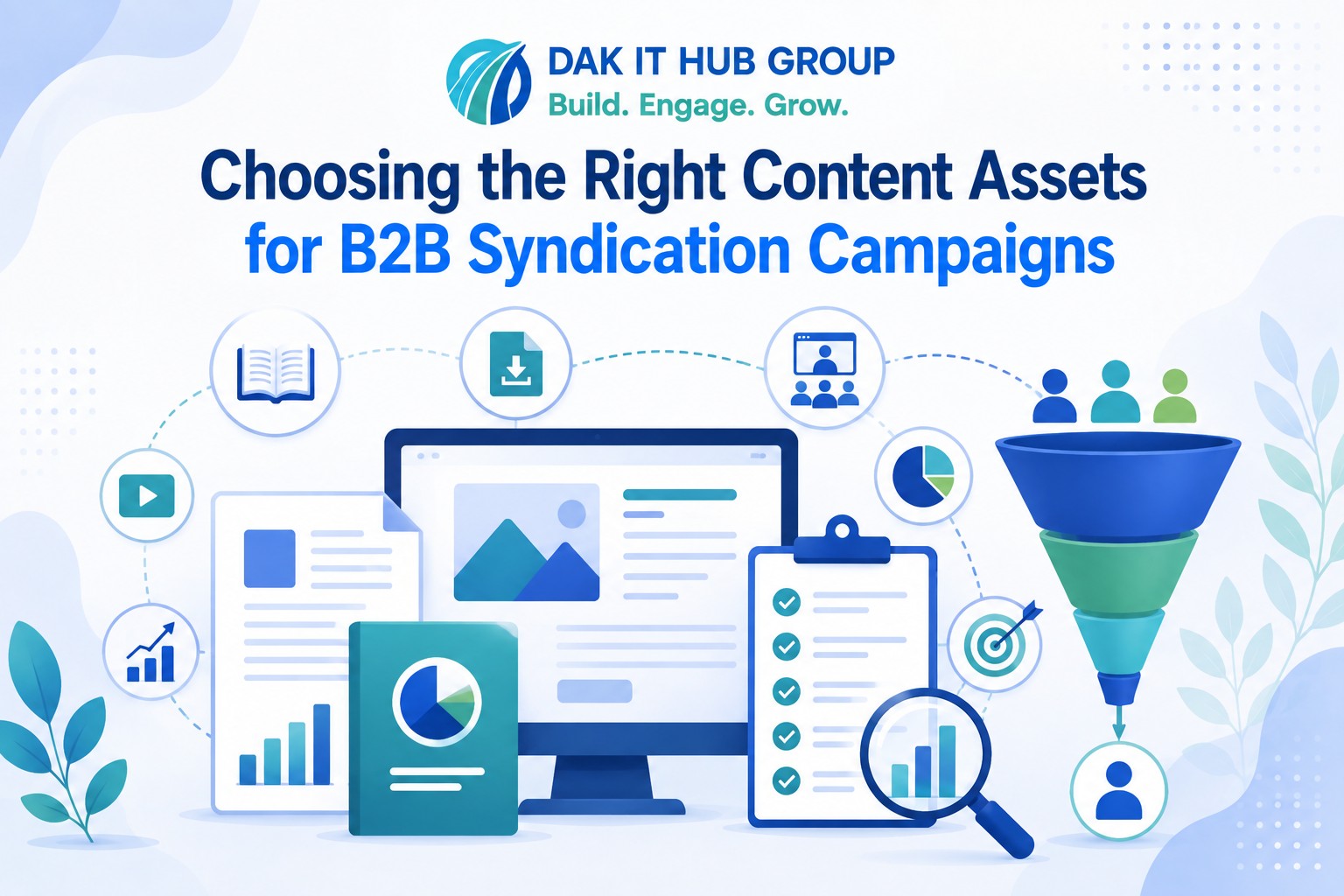
Content syndication is an effective way for B2B companies to expand the reach of their marketing content and connect with new prospects. However, simply distributing content to a larger audience does not guarantee strong results. The type, quality, and relevance of the content asset being promoted play an important role in attracting the right audience and generating qualified leads.
For B2B marketers, choosing the right content asset requires an understanding of the target audience, their challenges, their position in the buying journey, and the information they are looking for. A well-selected asset can encourage prospects to engage with a brand and provide valuable information that supports lead qualification.
In this blog, we explore how businesses can choose the right content assets for successful B2B content syndication campaigns.
Understand Your Target Audience First
Before selecting a content asset, marketers should clearly understand who they want to reach.
Important factors include:
- Industry
- Company size
- Job function
- Seniority
- Geographic location
- Business challenges
- Buying stage
- Areas of interest
For example, a technical whitepaper may work well for IT professionals, while an industry trends report may be more appealing to senior business executives.
Understanding the audience helps marketers select content that is relevant rather than simply promoting whatever asset is currently available.
Match Content With the Buyer’s Journey
Different prospects need different types of information depending on where they are in the buying process.
A prospect in the early research stage may prefer educational content that helps them understand a business challenge. A prospect closer to making a decision may be more interested in case studies, product comparisons, or detailed solution guides.
Content assets can generally be aligned with three broad stages:
Awareness: Blog articles, industry reports, research studies, and trend reports can help introduce a topic and create awareness.
Consideration: Whitepapers, eBooks, webinars, guides, and expert reports can provide deeper information and help prospects evaluate potential approaches.
Decision: Case studies, solution briefs, product guides, comparison documents, and demonstrations can support prospects who are closer to making a purchasing decision.
Matching the asset with the buyer’s stage can improve engagement and lead quality.
Whitepapers and Research Reports
Whitepapers and research reports are among the most commonly used assets in B2B content syndication.
They are particularly useful when the audience is looking for detailed information about an industry challenge, technology, or business trend.
A strong whitepaper should provide meaningful insights rather than simply promote a company’s products or services.
Research-based content can also help establish credibility and encourage professionals to exchange their contact information for access.
eBooks and Comprehensive Guides
eBooks are useful for explaining complex topics in a simple and structured format.
They can cover subjects such as:
- Industry challenges
- Technology trends
- Best practices
- Strategic planning
- Business transformation
- Operational improvements
Because eBooks typically provide more information than a standard blog article, they can be effective lead-generation assets when targeted toward relevant audiences.
Webinars and On-Demand Events
Webinars combine educational content with direct engagement.
A webinar can be especially effective when the topic addresses a current business challenge or emerging industry trend.
Content syndication can be used to promote webinar registrations among relevant professionals. After the event, recordings and on-demand sessions can also become valuable content assets for continued lead generation.
Webinars can provide additional engagement information, such as registration, attendance, session participation, and follow-up interactions.
Case Studies
Case studies are particularly valuable for prospects who want evidence that a solution can deliver real business results.
A strong case study should explain:
- The customer’s business challenge
- The solution implemented
- How the solution was applied
- The results achieved
- Key lessons from the experience
Case studies can work especially well with audiences that are already familiar with a particular problem and are evaluating potential vendors.
Infographics and Visual Content
Not every prospect wants to read a long document.
Infographics can present statistics, processes, trends, and key insights in a visually appealing format. They can be useful for generating initial interest and directing prospects toward more detailed resources.
However, visual assets should still provide meaningful information. A visually attractive asset with little practical value is unlikely to generate strong engagement.
Consider Content Quality and Relevance
The quality of the content matters as much as the format.
Before using an asset in a syndication campaign, marketers should ask:
- Does it address a genuine audience problem?
- Is the information useful and current?
- Is the topic relevant to the target industry?
- Does it provide actionable insights?
- Is the content easy to understand?
- Does it offer enough value to justify a prospect’s attention?
High-quality content creates a stronger reason for prospects to engage.
Create Different Assets for Different Personas
B2B buying decisions often involve multiple stakeholders.
An IT manager, finance executive, marketing leader, and procurement professional may all have different concerns about the same solution.
Instead of using one generic asset for everyone, businesses can develop or select content that addresses the priorities of different personas.
For example, technical audiences may prefer implementation guides, while executives may prefer research reports focused on business outcomes.
This approach can improve relevance and engagement.
Use Clear and Compelling Calls to Action
The content asset should have a clear purpose.
The call to action might encourage prospects to:
- Download a report
- Register for a webinar
- Access an eBook
- Request additional information
- Watch an on-demand session
- Speak with a representative
The CTA should be relevant to the content and appropriate for the prospect’s stage in the buying journey.
A strong call to action makes it easier for interested prospects to take the next step.
Measure Campaign Performance
Choosing the right content asset is an ongoing process.
B2B marketers should track metrics such as:
- Impressions
- Email open rates
- Click-through rates
- Content downloads
- Registration rates
- Lead volume
- Lead quality
- MQL conversion
- SQL conversion
These metrics help identify which assets generate the strongest engagement and the most valuable leads.
If a particular whitepaper generates many downloads but very few qualified leads, marketers may need to review the targeting, content topic, or qualification criteria.
Keep Testing and Optimizing
There is no single content format that works for every audience.
Businesses should experiment with different topics, formats, messaging, and audience segments. Comparing campaign results can reveal which combinations produce the best outcomes.
For example, one audience may respond strongly to research reports, while another may engage more with webinars or practical guides.
Continuous testing helps businesses improve content syndication performance over time.
Final Thoughts
Choosing the right content asset is one of the most important decisions in a B2B content syndication campaign. Businesses should consider their target audience, buyer journey, industry challenges, content quality, and campaign objectives before selecting an asset. Whitepapers, eBooks, research reports, webinars, case studies, guides, and infographics can all generate results when they are matched with the right audience and promoted with relevant messaging. A thoughtful content strategy can help businesses reach new prospects, increase engagement, and generate more meaningful B2B leads.
DAK IT HUB GROUP’s B2B lead generation services help businesses expand their reach and generate qualified opportunities through content syndication using targeted email marketing. By identifying relevant audiences, promoting valuable content assets, and connecting businesses with professionals who match their targeting requirements, DAK IT HUB GROUP helps sales and marketing teams generate new leads, expand market reach, and support a stronger B2B sales pipeline.


0 Comments