
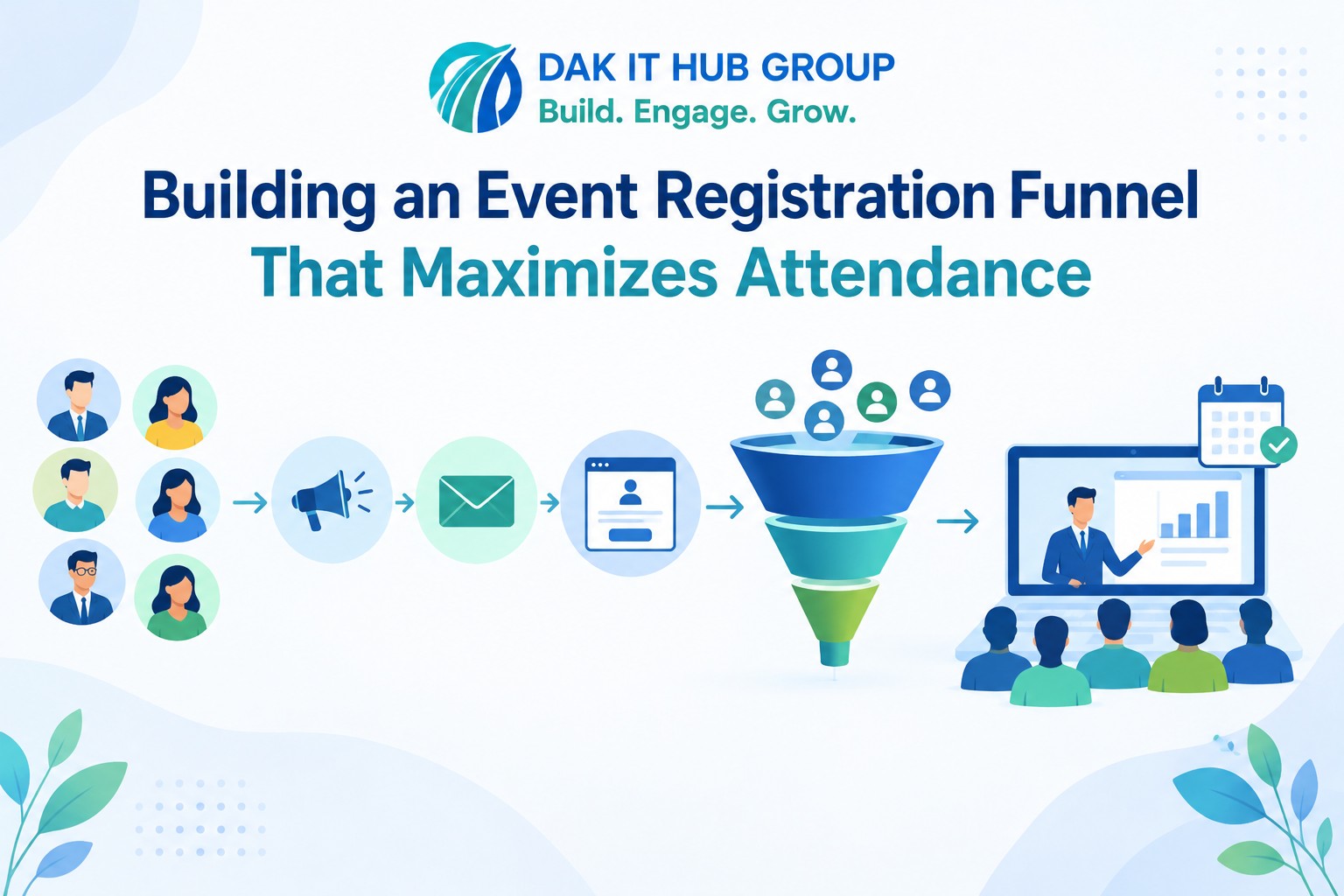
For B2B marketers, getting people to register for a webinar or virtual event is only the beginning. A registration does not guarantee attendance, engagement, or business impact. The real challenge is moving prospects through a structured journey—from discovering the event to registering, showing up, participating, and taking a meaningful next step afterward.
A well-designed event registration funnel treats registration and attendance as connected stages rather than separate marketing activities. This approach helps businesses attract the right audience, reduce no-shows, improve engagement, and create more opportunities for sales follow-up.
Current B2B webinar guidance consistently emphasizes that the gap between registrations and actual attendance can be substantial, making the post-registration experience just as important as the initial promotional campaign.
Start With the Right Target Audience
The foundation of an effective event registration funnel is audience quality.
Instead of promoting an event to an entire database, marketers should identify prospects who match their Ideal Customer Profile (ICP). Consider factors such as:
- Industry
- Company size
- Geography
- Job function
- Seniority
- Business challenges
- Technology environment
- Previous engagement
- Potential buying interest
A highly relevant audience is more likely to register because the event addresses a problem that matters to them. More importantly, relevant registrants are more likely to attend.
For B2B events, the objective should therefore be qualified registrations rather than registration volume alone.
Create a Value-Focused Registration Page
The registration page should immediately answer one important question:
“Why should I spend my time attending this event?”
A strong registration page should clearly communicate:
- The problem being addressed
- What attendees will learn
- Who should attend
- Key takeaways
- Speaker information
- Date and time
- Event duration
- A simple registration CTA
Avoid filling the page with unnecessary information. The registration experience should be straightforward, particularly on mobile devices.
The registration form itself should also avoid excessive fields. For B2B webinars, collecting basic information such as name, business email, company, and perhaps role or use case can provide useful qualification information without creating unnecessary friction.
Build a Multi-Channel Promotion Strategy
An event funnel should not depend on a single promotional message.
Email marketing can form the foundation of B2B event promotion, supported by other channels such as LinkedIn, website promotion, partner outreach, and targeted sales outreach.
Rather than sending one invitation, develop a sequence.
For example:
- Email 1: Introduce the event and its primary value
- Email 2: Highlight key discussion points or speaker expertise
- Email 3: Share a compelling insight or event benefit
- Email 4: Create urgency as registration closes
- Email 5: Final reminder for those who have not registered
Current B2B event guidance recommends multiple promotional touches rather than relying on a single invitation, with many registrations occurring during the final week before an event.
Treat Registration as the Start of the Funnel
One of the biggest mistakes marketers make is treating registration as the end goal.
Once someone registers, the business has an opportunity to maintain interest and increase the probability of attendance.
Immediately after registration, send a confirmation message containing:
- Registration confirmation
- Calendar invitation
- Event date and time
- Access information
- Speaker details
- Key takeaways
- Contact information for support
The confirmation should reinforce the value of the event rather than simply saying, “You are registered.”
Build a Strategic Reminder Sequence
Reminder emails are among the most important components of an attendance-focused funnel.
A practical sequence might include:
Immediately after registration: Confirmation and calendar invitation
3–5 days before: Reminder highlighting the value of attending
1 day before: Agenda and key takeaways
Morning of the event: Simple reminder with joining instructions
1 hour before: Short “starting soon” reminder
The objective is not to repeatedly send the same message. Each reminder should give the registrant another reason to remember why they wanted to attend.
Research and industry guidance commonly point to structured reminder sequences as an important way to reduce no-shows.
Use Personalization to Increase Relevance
Generic event invitations can easily get lost in crowded inboxes.
Personalization can make the event more relevant by referencing information such as:
- Industry
- Job role
- Business challenge
- Previous content engagement
- Account characteristics
For example, an invitation to a marketing director could emphasize pipeline generation, while an invitation to a sales leader could focus on qualified opportunities and sales productivity.
The objective isn’t simply to insert a prospect’s first name into an email. Effective personalization connects the event’s value proposition to the prospect’s business priorities.
Use Telemarketing to Strengthen Registration and Attendance
Email should not be the only communication channel in a B2B event funnel.
For high-value events, telemarketing can complement email campaigns by allowing representatives to directly engage targeted prospects.
A telemarketing team can:
- Introduce the event
- Confirm interest
- Answer questions
- Explain the event’s value
- Encourage registration
- Confirm attendance
- Remind registered prospects before the event
This can be particularly useful when targeting senior decision-makers or specific accounts where personalized outreach matters.
Make Attendance Easy
Even interested registrants can become no-shows if the joining process is complicated.
The event experience should make attendance as frictionless as possible.
Provide:
- A clear calendar invitation
- Simple joining instructions
- A prominent access link
- Correct time-zone information
- Technical requirements where necessary
- Support contact details
Avoid forcing registrants to search through old emails for the webinar link.
Engage Attendees During the Event
Attendance is important, but engagement provides another layer of value.
Use interactive elements such as:
📊 Polls
💬 Q&A sessions
🙋 Audience questions
📋 Surveys
🎯 Interactive discussions
These activities can also provide useful qualification signals.
Someone who asks a detailed question, participates in a poll, or remains engaged throughout the session may represent a stronger opportunity than someone who registers but barely interacts.
Segment Attendees and No-Shows
Not every registrant should receive the same follow-up.
At minimum, segment your audience into:
Attended: Follow up with event highlights and relevant next steps.
Registered but did not attend: Offer the recording and key takeaways.
Highly engaged attendees: Prioritize for sales follow-up.
Low-engagement attendees: Continue with appropriate nurturing.
No-shows should not automatically be considered lost leads. They have already demonstrated interest by registering. A useful recording or recap can bring them back into the engagement journey.
Measure the Entire Funnel
Registration volume alone is an incomplete measure of event success.
Track the funnel from beginning to end:
Targeted prospects → Landing-page visitors → Registrations → Attendees → Engaged attendees → MQLs → SQLs → Meetings → Opportunities
Important KPIs include:
- Registration conversion rate
- Cost per registration
- Registrant-to-attendee rate
- No-show rate
- Engagement rate
- Questions and poll participation
- Replay views
- MQL conversion
- SQL conversion
- Meetings generated
- Opportunities influenced
This broader measurement approach helps marketers understand whether an event is actually contributing to pipeline rather than simply generating registrations.
Continuously Optimize the Funnel
A successful event registration funnel should improve after every campaign.
Review where prospects are dropping out.
If registrations are low, revisit the audience, messaging, landing page, and promotional channels.
If registrations are strong but attendance is weak, improve the confirmation and reminder sequence.
If attendance is strong but sales opportunities are limited, examine audience quality, event content, engagement, qualification, and post-event follow-up.
This creates a continuous optimization cycle rather than treating every webinar as an isolated campaign.
Final Thoughts
Building an event registration funnel that maximizes attendance requires much more than creating a registration page and sending an invitation. Businesses need to connect targeted audience selection, compelling event messaging, frictionless registration, personalized email promotion, strategic reminders, direct outreach, engaging event experiences, and structured follow-up into one continuous journey. When every stage is optimized, webinars and virtual events can become more than registration-generating campaigns—they can become repeatable B2B demand-generation and pipeline-building programs.
DAK IT HUB GROUP’s B2B webinar & event registration services help businesses improve attendance by combining targeted email marketing and telemarketing. By reaching relevant prospects, promoting events with targeted messaging, following up with registrants, and using direct telemarketing to encourage attendance, DAK IT HUB GROUP helps sales and marketing teams increase qualified registrations, reduce no-shows, and create more valuable opportunities from their webinar and event programs.
0 Comments